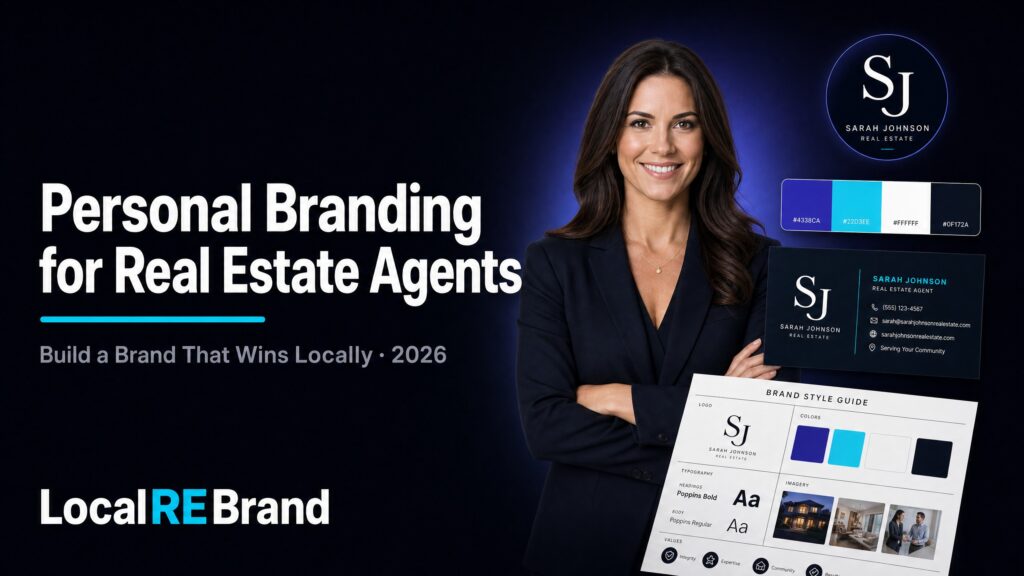
Answer Summary
Personal branding is what makes a real estate agent the obvious choice in a market full of options. In 2026, the agents who win are not generalists with polished logos — they are clearly positioned specialists whose niche, voice, and visual identity all reinforce the same story. The math is unambiguous: agents who invest in a cohesive brand refresh report 371% more leads and 3.5x more property views within nine months. The system is five layers: niche, positioning statement, visual identity, brand voice, and content presence. Build the layers in that order and your brand becomes a moat.
Key Takeaways
- Agents who specialize in a defined niche (geographic, demographic, or property type) consistently outperform generalists on lead quality, referral volume, and commission per transaction (Designing IT, 2026).
- Agents who invest in a cohesive brand refresh report 371% more leads and 3.5x more property views within 9 months (Ramotion, 2026).
- The 2026 visual identity trend: quieter palettes — charcoal, white, soft metallics. Black and white dominates top-producer logos.
- Logos should be timeless (7–15 year lifespan). Frequent rebrands signal trend-chasing, not strategy.
- Brand voice is defined by 3–4 adjectives (e.g., “warm, expert, direct, community-focused”) and applied consistently across every channel.
- Niche selection beats brand polish. A clearly positioned generalist-looking agent still loses to a specialist with mediocre design.
Why Personal Brand Is the Real Competitive Moat
In 20 years of working with real estate agents, the single biggest predictor of long-term success isn’t talent, isn’t budget, isn’t even market timing. It’s clarity.
The agents who win consistently — across decade-long careers, multiple market cycles, brokerage changes — are the ones whose brand answers a specific question: who is this agent for, and what are they uniquely good at?
The agent who can answer that crisply in one sentence beats the agent who can’t, every time. Doesn’t matter if the second agent has a better headshot.
This pillar is the full personal branding system: from niche definition through visual identity through ongoing voice — built for agents who want to compete on positioning, not on commission discounts.
The 5-Layer Brand Stack
Build your brand in this order. Skipping layers or building out of sequence produces brands that look polished but don’t convert.
Layer 1: Niche. Who you serve. Specific.
Layer 2: Positioning statement. What you do for them, and why you’re different.
Layer 3: Visual identity. How your brand looks (logo, colors, typography, imagery).
Layer 4: Brand voice. How your brand sounds (in writing, on video, in conversation).
Layer 5: Content presence. Where your brand shows up and what it says consistently.
Most agents start at layer 3 (logo) and never go back to layer 1. That’s why most real estate agent brands look professional and convert poorly.
Layer 1: Pick a Niche (Without Limiting Your Business)
The biggest objection to niching down: “I don’t want to turn away business.”
The data: niched agents earn more, not less. The 2026 reports across multiple sources show specialists outperform generalists on lead quality, referral volume, and average commission per transaction.
Why niching works:
- You become the obvious choice for the specific people you serve
- You build deeper expertise faster (because you see the same patterns repeatedly)
- Your marketing becomes more specific and therefore more effective
- Your referral network sends you the right type of client
- Other agents send you their out-of-niche referrals (luxury agents send first-time buyers to you, you send your luxury clients to them)
The 3 niche dimensions:
Geographic: “I specialize in Park Hill, Stapleton, and Lowry — Denver’s east side neighborhoods.” The most common and often the strongest.
Demographic: “I help first-time homebuyers in Denver.” “I work with executive relocations.” “I serve retirees downsizing in the Denver metro.”
Property type: “I sell luxury homes in Denver’s Country Club.” “I specialize in multi-family investment properties.” “I work exclusively with new construction.”
The strongest niches combine two of the three. “Luxury homes in Cherry Creek” (geographic + property type). “Executive relocations to Stapleton” (demographic + geographic). “First-time buyers in Denver’s east-side neighborhoods” (demographic + geographic).
The fear of niching is the fear of being seen as small. The reality is the opposite: a tightly positioned agent is seen as the expert, and experts are the people clients actually want to work with for the biggest financial decision of their lives.
Full niche-selection methodology in How to Define Your Real Estate Niche (Without Limiting Your Business).
Layer 2: Your Positioning Statement
Your positioning statement is the sentence that answers who you serve, what you do for them, and why you’re different. It is the foundation of every piece of marketing copy you’ll ever write.
The formula:
“I help [specific client] [achieve specific outcome] in [specific market] through [your specific approach].”
Examples:
- “I help first-time homebuyers in Denver’s east-side neighborhoods navigate their first purchase with a step-by-step process designed for buyers who’ve never done this before.”
- “I help executives relocating to Denver find homes in Stapleton, Park Hill, and Cherry Creek using a remote-first consultation process built for time-constrained professionals.”
- “I help downsizing retirees in the Denver metro transition from family homes to right-sized properties with a relocation team and concierge support.”
Three rules:
- Specific over universal. “First-time homebuyers in Denver” beats “buyers.”
- Outcome over feature. “Navigate their first purchase” beats “help them buy a home.”
- Approach over claim. “Step-by-step process designed for first-time buyers” beats “expert service.”
Your positioning statement lives in your website header, GBP description, social media bios, business cards, and every introduction you give. It doesn’t change. It becomes your identity.
Layer 3: Visual Identity (Logo, Colors, Typography)
Visual identity matters — but less than agents think. A great visual identity won’t save bad positioning. Bad visual identity will, over time, undermine great positioning.
The 2026 visual identity rules:
Logos:
– Simple, scalable, readable at every size (16px favicon to 10ft signage)
– Black and white as default — the top-producing agent logos in 2026 are dominated by black and white (Luxury Presence, 2026)
– One color or color family (if any color at all)
– Timeless typography — sans-serif (Inter, Montserrat, Avenir) or classic serif (Playfair, Cormorant)
– 7–15 year lifespan — if you’re rebranding more often than that, your previous identity was trend-chasing
Color palette:
The 2026 move is toward quieter palettes — charcoal, white, soft metallics.
- Black + metallic: luxury, high-end
- Navy + cream: established, trustworthy, classic
- Charcoal + warm neutrals: modern, approachable
- Deep green + cream: suburban family, growth-oriented
- Burgundy + cream: traditional, heritage
Avoid: bright reds (aggressive in real estate context), neon anything, overdesigned gradients, 5+ colors.
Typography:
– One serif + one sans-serif maximum
– Headings + body, no more
– Web fonts that load fast (Google Fonts or local)
Photography:
– Professional headshot, refreshed every 3 years minimum
– Branded photo style (consistent color grading, similar lighting, recognizable feel)
– Original photography of your neighborhoods, listings, community moments
– Stock photos used sparingly and never as primary brand imagery
The full visual identity playbook is in Real Estate Logo Design: What Agents Should (and Shouldn’t) Do, Your Real Estate Color Palette: A Brand Guide for Agents, and How to Pick a Real Estate Agent Headshot That Builds Trust.
Layer 4: Brand Voice
Brand voice is how your brand sounds. Defined by 3–4 adjectives applied consistently across every piece of writing, every video, every conversation.
Examples of brand voice combinations:
- “Warm, expert, direct, community-focused” — for a sphere-driven generalist
- “Sophisticated, calm, precise, exclusive” — for a luxury agent
- “Approachable, knowledgeable, energetic, neighborhood-rooted” — for a hyperlocal specialist
- “Strategic, data-driven, candid, professional” — for an investment-focused agent
Once defined, voice rules apply everywhere:
- Email copy
- Social media captions
- Video scripts
- Website pages
- Listing descriptions
- Client communications
- Marketing materials
The voice consistency test: Can someone read three pieces of your content with the logo removed and identify it as yours? If not, voice isn’t consistent enough.
The voice authenticity test: Does your brand voice sound like you? If you write captions that read nothing like how you speak in person, you have a voice problem — readers feel the disconnect even if they can’t name it.
Full brand voice methodology in Brand Voice for Real Estate Agents: How to Sound Like You (Not a Robot).
Layer 5: Content Presence
The brand stack only matters if it’s visible. Layer 5 is where the brand shows up consistently across:
- Website (covered in Real Estate Website SEO)
- Google Business Profile (covered in GBP Mastery)
- Social media (covered in Social Media Marketing)
- Video (covered in Video Marketing)
- Email (covered in Email Marketing)
- Content marketing (covered in Content Marketing)
- In-person presence (signage, business cards, listing presentations, open houses)
Visual identity carries through to every touchpoint. Voice carries through to every word written or spoken. Positioning is reinforced in every interaction.
The agents who win at brand are the ones whose Instagram, email signature, listing presentation, and open house signage all feel like the same person — because they are.
Real Estate Tagline / Slogan Development
A great tagline is short, specific, evergreen, and reinforces your positioning. A bad tagline is generic, trend-chasing, or too clever to remember.
Rules:
– 7 words or fewer
– Memorable and easy to say aloud
– Evergreen (no year references, no fleeting metrics)
– Tied to your positioning, not generic real estate language
Examples that work:
- “Real estate, made local.” (hyperlocal specialist)
- “Helping Denver families find home.” (sphere/family generalist)
- “Concierge real estate for time-pressed professionals.” (relocation specialist)
- “Where Park Hill begins.” (neighborhood specialist)
- “The expert your friends recommend.” (referral-based)
Examples that don’t:
- “Your trusted real estate advisor.” (every agent says this)
- “Where your dreams come home.” (clichéd)
- “2026’s #1 Denver Realtor!” (year reference + unverifiable claim)
- “Luxury homes for the discerning client.” (generic luxury)
Full tagline development guide in Real Estate Tagline Examples That Actually Work (With Formulas).
When (and How) to Rebrand
Rebranding is sometimes the right move. Often it’s procrastination dressed up as strategy.
You probably need to rebrand if:
- Your brand was built around your old brokerage and you’ve changed firms
- You’ve niched down (or up) significantly and your brand still says “generalist”
- You’re partnering with someone and forming a team
- Your visual identity looks dated (>10 years old, trend-based, doesn’t scale digital)
- You’re getting consistent feedback that your brand doesn’t match your current business
You probably don’t need to rebrand if:
- Business is slow and you think a new logo will fix it (it won’t)
- You’re bored
- You saw a competitor’s nice rebrand
- You’re chasing a trend
A well-executed rebrand modernizes the visual while keeping equity. A poorly executed rebrand throws away years of recognition for marginal aesthetic gains.
Sequence to do it right:
- Audit the existing brand (what’s working, what isn’t, why)
- Reaffirm or redefine positioning (Layer 1 + 2)
- Hire professional visual identity work (don’t DIY beyond a starter brand)
- Plan the rollout — 60–90 days, all assets updated systematically
- Announce intentionally — frame it as evolution, not collapse
Full rebrand playbook in Renaming Yourself or Your Team: When and How to Rebrand.
Personal Brand on a Solo Agent Budget
You don’t need a $20K branding agency for a great brand. The brand fundamentals are positioning and voice — both of which are free.
The solo agent budget brand stack:
- Niche selection + positioning statement: free (your work)
- Brand voice: free (your work + voice exercises)
- Logo: $200–$1,500 (99designs, Looka, or freelancer on Upwork)
- Color palette: free (use Coolors.co with your reference palettes)
- Typography: free (Google Fonts)
- Professional headshot: $200–$600 (annual or biennial)
- Website template + customization: $500–$2,000
- Branded business cards + signage: $300–$800
Total starter brand investment: $1,200–$5,000.
The biggest waste of money is spending $20K on visual identity before you’ve nailed positioning. The biggest waste of opportunity is having clear positioning and inconsistent visual presence.
Full budget brand guide in Building a Real Estate Brand on a Solo Agent Budget.
Brand Consistency: The Discipline That Compounds
The hardest part of branding isn’t building the brand. It’s maintaining it consistently for years.
The brand consistency checklist:
- Same logo everywhere (no variations)
- Same colors everywhere (document the hex codes)
- Same typography on website, marketing, and email
- Same headshot across GBP, social, website (until you formally refresh)
- Same positioning statement language across every bio
- Same brand voice in every piece of copy
- Same visual style for photography and graphics
- Same email signature across all team members
Create a 1-page brand guide. Distribute to anyone who creates content for you (designers, VAs, team members). Review quarterly.
The agents who maintain brand consistency for 3+ years become recognized. The agents who tweak something every few weeks stay invisible.
Measuring Brand Strength
Brand metrics are harder to track than other channels but they exist.
What to track:
Awareness:
– Direct traffic to your website (people typing your URL or searching your name)
– Branded search volume in Google Search Console
– Social media follower growth (vanity but directionally useful)
– “Mentioned your name” feedback in client conversations
Trust:
– Email open rates and reply rates
– Inbound message quality (“I’ve been following you for a while…”)
– Referral volume
– Time-to-conversion on new leads (lower = stronger brand)
Conversion:
– Inbound leads attributed to direct/branded search
– Premium listings won versus competitor agents
– Commission negotiation outcomes
– Referral close rates vs. cold lead close rates
The strongest signal: when people refer to you by name without a qualifier (“Talk to Jon” vs. “talk to a real estate agent”). That’s brand working.
The 30/60/90 Brand Plan
Days 1–30: Foundation.
– Niche decision (write it down, commit)
– Positioning statement (5 drafts, pick one)
– Brand voice adjectives (3–4)
– Existing brand audit
– Decision: refresh existing or rebrand
Days 31–60: Visual identity.
– Logo work (freelancer or agency)
– Color palette and typography decisions
– Professional headshot (if needed)
– 1-page brand guide document
Days 61–90: Rollout.
– Website updates
– GBP refresh
– Social media profile updates across all platforms
– Email signature updates
– Business cards and signage reprint
– Announce the refresh (intentional, framed as evolution)
After 90 days you have a cohesive brand. The next 12 months are about consistency and recognition compounding.
Frequently Asked Questions
Q: Should my brand name be my personal name or a business name?
For solo agents: your personal name (Jon Smith Real Estate). For teams: a team name + your name (The Smith Group | Jon Smith). Your personal name is the most portable asset you have — it follows you across brokerage moves.
Q: How specific should my niche be?
Specific enough that someone in your niche immediately recognizes themselves. “First-time homebuyer in Denver” is specific. “Helping people in Colorado” is not.
Q: Can I have more than one niche?
Yes, but lead with one. You can serve adjacent niches (e.g., first-time buyers + sellers in the same neighborhood) but your primary marketing voice should be unified.
Q: How often should I refresh my brand?
Major rebrand: every 7–15 years if at all. Minor refresh (headshot, photography, color updates): every 3 years. Brand guide review: quarterly. Brand consistency check: monthly.
Q: I’m at a big franchise brokerage. How do I build a personal brand?
Work within the brokerage’s guidelines (most franchises have brand standards) while differentiating through your niche, voice, and content. Your headshot, neighborhood expertise, and content presence are yours — the franchise’s brand wraps around them.
Q: My headshot is from 5 years ago. Does it matter?
Yes. Outdated headshots erode trust at the moment of first contact. Refresh every 3 years minimum. The cost is $200–$600. The ROI is faster trust-building on every lead.
Q: Should my logo be a wordmark or a symbol?
Wordmark (just your name in styled type) is usually safer and more memorable for solo agents. Symbols + wordmarks make sense for teams and brokerages. Symbols alone (no name) are risky unless you have significant brand recognition.
What to Do This Week
If you only do five things this week:
- Write your niche definition. One sentence. Commit.
- Draft your positioning statement. Use the formula. Test it on 5 people.
- Pick 3–4 brand voice adjectives. Document them.
- Audit your current visual identity for consistency across website, GBP, social, email signature, business cards. Note inconsistencies.
- Take one piece of inconsistent content and fix it this week (the worst offender first).
For a free 30-minute personal brand strategy session, book here.
Jon Smith is a 20+ year SEO veteran who has built and refreshed brands for hundreds of real estate agents across North America. Connect on LinkedIn or read more on LocalReBrand.com.
Sources & further reading:
- Personal Branding for Real Estate Agents 2026 — Designing IT
- Real Estate Agent Branding Guide 2026 — Market Leader
- The 5 Most Profitable Real Estate Niches — Luxury Presence
- 22 Great Real Estate Logos in 2026 — Luxury Presence
- Mastering the Art of Real Estate Branding — Luxury Presence
- Real Estate Branding: Elements & Examples — Ramotion
- Real Estate Logo Design: 50+ Examples — Trem Group