Answer Summary
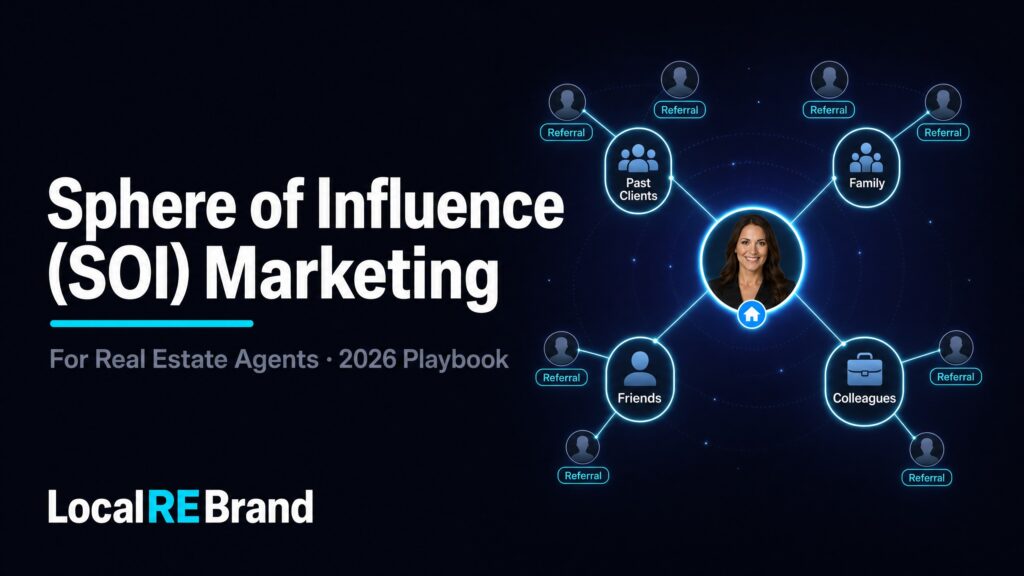
Sphere of Influence (SOI) marketing is the practice of systematically nurturing the people who already know you (friends, family, past clients, vendors, community contacts, social acquaintances) so they become a recurring source of repeat and referral business. The 2026 benchmark: every database contact gets 100 touches per year, and for every 7 people in your SOI, you can expect 1 transaction per year. A 200-person well-maintained SOI produces 28 transactions annually. The system: build the database, segment by relationship strength, execute the 100-touch annual plan via mixed channels (email, mail, phone, social, in-person), and stay relentlessly consistent for years.
Key Takeaways
- The 7:1 SOI ratio: for every 7 people in a well-maintained SOI database, you can expect 1 transaction per year (Rev Real Estate School).
- The 100-touch benchmark: every SOI contact gets 100 touches across a year — email, mail, calls, social, in-person, events, mixed.
- Newer agents start with 100–200 contacts; experienced agents manage 300–500+ with proper systems and segmentation.
- Add 2–5 new people to your database every week — 500 warm contacts within a year of disciplined growth.
- 66% of sellers chose their agent through a referral or prior relationship per NAR 2025 — SOI is the #1 source of seller leads.
- Mastermind groups (4–8 people) create the repetition, honesty, and pressure that one-off networking events can’t.
Why SOI Is the Foundation of Every Sustainable Real Estate Business
Twenty years in this business, every successful real estate agent I’ve worked with has one thing in common: they built a strong, intentional, systematically-nurtured SOI.
The agents who chase paid leads to compensate for a weak SOI are running uphill forever. The agents who treat their SOI as the foundation and paid leads as the supplement build sustainable, predictable businesses.
The math:
- 41% of an experienced agent’s business comes from past clients + referrals (NAR 2025)
- 66% of sellers chose their agent through referral or prior relationship
- Cost per deal from SOI: ~$50–$200 in nurture cost
- Cost per deal from Zillow leads: $400–$2,200
SOI isn’t a “nice to have” channel — it’s the highest-margin channel available to a real estate agent. This pillar is the complete system.
What’s in an SOI (And What Isn’t)
An SOI is people who know you well enough to remember you when real estate comes up.
Who’s in your SOI:
- Family (close + extended)
- Friends (current + childhood + college + work)
- Past clients
- Vendors and referral partners (lender, title, inspector, photographer, stager, lawyers, contractors)
- Coworkers and former coworkers
- Neighbors (current + past)
- People you see weekly (yoga class, kids’ school, church, gym)
- Civic and association members (Rotary, Chamber, neighborhood association)
- Industry peers (other agents in adjacent markets)
Who’s not (yet):
- Cold leads who don’t know you personally
- Email subscribers from your website who haven’t responded
- Social media followers you’ve never spoken to
The line: if you ran into them at a coffee shop and they’d say hi by name, they’re in your SOI. If they wouldn’t, they’re a lead — and your job is to develop them into SOI over time.
Building the SOI Database (From Zero or Anywhere)
The database build is a one-time intensive followed by perpetual maintenance.
The initial build (weekend project):
- Brain dump everyone you know. Phone contacts. Email contacts. Holiday card list. LinkedIn connections. Facebook friends. Set aside 2 hours.
- Add their info. Name, email, phone, address (where known), how you know them.
- Add anniversary dates if they’ve used you as their agent. Birthdays if you know them.
- Tag by relationship strength (covered below).
- Import into your CRM.
Most new agents start at 75–200 names. Experienced agents come in at 300–500+. Either way: get them into one database, clean and tagged.
The weekly maintenance (15 minutes):
Add 2–5 new people to your SOI every week. Sources:
– People you met at events
– New vendors you’ve worked with
– Past clients you’ve forgotten to add
– Acquaintances who’ve recently engaged with you (replied to an email, attended an open house, etc.)
Over a year: 100–250 new SOI members from weekly maintenance alone.
Full database build guide in SOI Database Setup for Real Estate Agents.
Segmenting Your SOI (Tiers and Touch Rate)
Not every SOI contact deserves the same level of investment. Segment for efficiency.
Tier 1: Top SOI (closest relationships, highest referral potential).
– 25–50 people
– Personal calls 4+ times per year
– Pop-by gifts 4–6 times per year
– Personal birthday/anniversary outreach
– First invite to client appreciation events
– Touches per year: 36–60+
Tier 2: Active SOI (warm relationships, regular contact).
– 75–150 people
– Personal call 1–2 times per year
– Pop-by gifts 2–4 times per year
– Monthly email/newsletter
– Touches per year: 24–36
Tier 3: Database (people who know you, less regular contact).
– Everyone else
– Monthly email/newsletter
– Annual personal touch (birthday, holiday card)
– Touches per year: 12–18
A 200-person SOI distributed: 30 Tier 1, 100 Tier 2, 70 Tier 3 = roughly 36-touch average × 200 people = 7,200 total annual touches.
With automation + batching, that’s executable in 4–6 hours per week.
The 100-Touch Annual Plan
The benchmark for top-producing agents: 100 touches per top-tier SOI contact per year.
That sounds enormous. In practice, here’s how 100 touches per top contact breaks down:
| Channel | Touches per year | Time commitment |
|---|---|---|
| Newsletter | 12 | Batch-produced |
| Social media engagement | 12 | Daily habit |
| Email (personal) | 6 | 15 min each |
| Phone calls | 4–6 | 5–15 min each |
| Text messages | 6–10 | 1–2 min each |
| Pop-by gifts | 4–6 | Batched delivery |
| Direct mail | 4 | Batched |
| Client events | 2–4 | Quarterly |
| Birthday/anniversary | 2 | Personal |
| Spontaneous touches | 5–10 | Opportunistic |
| Total | ~70–110 |
The “100 touches” is more accurately “70–110 across diverse channels.” The point is the multiplication of channels, not strict counting.
Full annual plan in The Annual SOI Marketing Calendar for Real Estate Agents.
Communication Cadence: How Often Is Too Often
The honest answer: cold SOI cadence (less than monthly) is the bigger danger. Over-communication is rare.
Recommended cadence by tier:
- Tier 1: Some form of personal touch every 2–3 weeks. Newsletter monthly. Phone or text quarterly minimum.
- Tier 2: Newsletter monthly. Personal touch every 60–90 days.
- Tier 3: Newsletter monthly. Annual personal touch.
When over-communication becomes a problem:
- Daily-frequency emails (unless they signed up for something specifically frequent)
- Generic sales push without value
- Same content sent to everyone without segmentation
- Pressure tactics (“Are you ready to sell?”)
The reciprocity rule: every commercial-feeling touch should be balanced by 3–4 value-adding touches. People who only hear from you when you want something stop responding.
Full cadence framework in SOI Communication Cadence: How Often Is Too Often?.
Networking for Real Estate Agents: Events That Are Worth It
Networking is part of SOI growth — but most networking events are time-wasters. The events that produce ROI:
Tier 1: High-ROI events.
- BNI (Business Network International) chapters. Structured weekly meetings, exclusive industry representation, reciprocal referral expectation. Best for agents committed long-term.
- Chamber of Commerce networking mixers. Lower commitment, broader audience, good for community embedding.
- Local business / professional groups. Often industry-specific (lawyer associations, healthcare professionals, etc.) — good if you target that demographic.
Tier 2: Moderate-ROI events.
- Real Estate Investors Association (REIA) meetings. If you serve investors.
- Charity and nonprofit events. Community presence + occasional referrals.
- Industry-adjacent events (home builder showcases, mortgage broker networking).
Tier 3: Low-ROI for most agents.
- Generic “networking after hours” events
- Large conferences with 1,000+ attendees (too big to make real connections)
- Speed networking events (too superficial)
The rule: pick ONE high-ROI event and commit for 12 months. Spreading thin across BNI + Chamber + Rotary + REIA + a mastermind in your first year produces zero results (Ashby & Graff Careers, 2026).
Full event guide in Networking for Real Estate Agents: Events That Are Worth It.
Mastermind Groups: The Compounding Force Multiplier
A mastermind is a small group (4–8 people) of peers who meet regularly to discuss challenges, share strategies, and hold each other accountable.
Why masterminds work:
- Repetition (regular meetings build the relationship over time)
- Honesty (small group enables direct feedback that big networking events can’t)
- Pressure to improve (accountability to peers)
- Cross-pollination of ideas across markets/specialties
How to find or start a mastermind:
- Join an existing one (paid or free) — Investor Fuel, The Genius Network, local agent groups
- Start your own with 4–7 people you respect
- Look outside real estate too — masterminds with adjacent industries (financial advisors, business consultants, attorneys) often produce more useful cross-pollination
Mastermind format:
- Monthly or bi-weekly meetings, 90 minutes
- Same time each session (consistency matters)
- Hot seat format (each member gets focused time on their challenges per meeting)
- Confidentiality expected (creates space for honesty)
- Accountability: each member states one commitment, reports back next meeting
Full guide in Real Estate Mastermind Groups: How to Join or Start One.
Vendor Networking: The Underrated Growth Channel
Beyond personal SOI, vendor partnerships are some of the most consistent referral sources available.
The vendors who can refer you:
- Mortgage lenders (early-funnel referrals)
- Title companies (transactional + post-close referrals)
- Home inspectors (often refer buyers in market)
- Estate planning attorneys (inherited property situations)
- Divorce attorneys (transaction-triggering events)
- Financial advisors (investment property + downsizing)
- Insurance agents (life-event triggers)
- General contractors (renovation → sale)
- Stagers (pre-sale clients)
- Real estate photographers (other agents’ clients)
Building the vendor network:
- Identify 1–2 top vendors per category
- Refer them consistently — every buyer to your lender, every seller to your stager
- Stay in touch through your normal newsletter cadence + occasional check-ins
- Provide value beyond referrals (mention them in newsletter, tag them in social, attend their events)
- Track which vendors actually reciprocate — drop the ones who only take
Some agents generate 30–50% of their business through vendor networks alone after 5+ years of building.
Full strategy in Vendor Networking: The Underrated Real Estate Growth Channel.
The “Database 100” Strategy
The Database 100 is a specific subset of your SOI: the 100 people most likely to give you a transaction or refer one this year.
Building your Database 100:
- Top 25 from your past clients (recent + high-engagement)
- Top 25 from your friends and family (people who’d actively refer)
- Top 25 from your vendor + professional network
- Top 25 from your active community/social network
The Database 100 plan:
- Personal touch every 4–6 weeks (call, text, in-person, meaningful email)
- Quarterly value drop (something specifically useful to them, often non-real-estate)
- Special events invitations
- Top priority on your time and attention
Why it works:
100 well-nurtured people consistently produces 15–20 transactions per year for established agents. That’s the equivalent of a $150K–$300K+ in commission income from one focused group. Other agents try to manage 1,000+ “leads”; the Database 100 agent quietly outperforms them.
Full implementation in The Real Estate “Database 100” Strategy.
Turning Friends Into Clients (Without Being Weird)
Many new agents struggle with the awkwardness of working with people they already know. The framework that works:
1. Decide once. Are you serving your friends in real estate? Yes or no. Most agents say yes but signal no through behavior.
2. Tell people you’re in real estate. Not as a pitch — as information. “I started in real estate this year. If anyone ever has questions, I’m happy to help — no pressure either way.”
3. Treat friends as clients, not friends. When you’re working a transaction, professional standards apply. After closing, you’re friends again.
4. Don’t undercharge friends. Discounting commission for friends sets bad expectations and often damages the relationship more than helps it. Full service, full commission.
5. Communicate explicitly about what to expect. Friend transactions can blur lines. Have the “this is what I’ll do as your agent, and this is what we’ll keep separate” conversation upfront.
6. Earn the right by being excellent. When friends see you do good work for other clients, they refer you. When they see you struggle or under-deliver, they don’t.
Full framework in How to Turn Friends Into Clients (Without Being Weird).
SOI Marketing Calendar
A repeatable annual calendar for SOI engagement:
January: Year-ahead market outlook newsletter. Personal calls to top 25.
February: Valentine’s pop-by. Heart-themed direct mail.
March: Spring market kickoff newsletter. Personal touch to next 25.
April: Spring pop-by. Tax-time gentle relevance.
May: Mid-year market check-in. Mother’s Day acknowledgment.
June: Summer pop-by. Phone outreach round 2.
July: Summer event hosting season — backyard BBQ for sphere.
August: Back-to-school newsletter (school district info, market timing).
September: Fall pop-by. Personal check-ins.
October: Halloween-themed touch. Direct mail piece.
November: Thanksgiving outreach — handwritten cards to top 100.
December: Holiday pop-by + client appreciation event + year-end gratitude.
Repeat annually. Add events, refine, but maintain the cadence.
Full calendar in The Annual SOI Marketing Calendar for Real Estate Agents.
Measuring SOI Performance
The SOI metrics that matter:
Database health:
– Total active SOI contacts
– New additions per week
– Verified contact info percentage
– Engagement rate (replies, opens, responses)
Touch execution:
– Touches per Tier 1 contact (target: 36–60+)
– Touches per Tier 2 contact (target: 24–36)
– Touches per Tier 3 contact (target: 12–18)
– Newsletter open rate (target: 25%+)
Outcome metrics:
– SOI-attributed leads
– SOI-attributed closings
– Referral volume per quarter
– Net Promoter Score (annual survey)
Compounding signal: When 50%+ of your annual transactions come from past clients + SOI referrals, your system is working.
Track quarterly. Most agents who do this seriously hit the 7:1 ratio (1 transaction per 7 SOI members per year) by year 3.
The 30/60/90 SOI Plan
Days 1–30: Database build.
– Brain dump all contacts
– Import to CRM, deduplicate, verify
– Tag by tier (1, 2, 3)
– Send first monthly newsletter
– Personal call to top 25
Days 31–60: Cadence.
– Continue newsletter
– First pop-by round to top 50
– 25 more personal calls
– Confirm Tier 1 list
– Build out 100-touch annual plan
Days 61–90: Compound.
– Continue cadence
– First quarterly review of touches sent
– First referral asks integrated into conversations
– Track first SOI-attributed leads
– Plan Q3 events and outreach
After 90 days you have an SOI system in motion. Years 2 and 3 are where the compounding shows up in your deal count.
Frequently Asked Questions
Q: How big does my SOI need to be to make a living?
At the 7:1 ratio, 100 SOI members = 14 transactions/year (~$140K–$280K commission at average rates). 200 SOI members = 28 transactions/year. Most full-time agents need at least 150–200 well-maintained SOI contacts for consistent income.
Q: I’m new and don’t know many people. What do I do?
Start with 50 — every relationship counts. Focus on adding 5+ per week through intentional networking, community involvement, and asking for introductions. Within 12 months you’ll be at 250+.
Q: How do I keep track of touches across so many people?
CRM is mandatory. Manual tracking falls apart past 50 contacts. Follow Up Boss, BoomTown, Wise Agent, Sierra Interactive all handle this well.
Q: Should I include people I haven’t talked to in 5+ years?
Sometimes. If you have a positive memory and they’d recognize your name, yes. If they wouldn’t, no. Use judgment, but err on inclusion — re-engaging dormant contacts is a real source of business.
Q: What’s a “touch” — does sending a generic email to my whole list count?
Yes, but barely. Generic touches matter less than personal ones. Aim for a mix: every Tier 1 contact gets at least 4–6 personal touches per year (calls, texts, real notes, in-person), plus the generic touches (newsletter, mass email).
Q: What if someone unsubscribes from my newsletter?
Don’t take it personally. Note it in the CRM, drop them from email but keep them in SOI for personal touches (calls, texts, in-person). Some people unsubscribe because they don’t want commercial email — they may still want to work with you.
Q: Should I prospect strangers (cold call, door-knock) or stick with my SOI?
SOI first, prospecting second. SOI produces higher conversion at lower effort. Once your SOI is producing 60%+ of your goal, supplement with prospecting if needed for growth.
What to Do This Week
If you only do five things this week:
- Brain dump your SOI. 2 hours, every contact you know. Get it all into one place.
- Tag by tier. 1, 2, or 3 for every contact.
- Send your first monthly newsletter (or this month’s edition if you already do this).
- Schedule personal calls to your top 10 for the next 2 weeks. 10 minutes each.
- Calendar block 4 hours per week for SOI work. Same time every week. Forever.
For a free 30-minute SOI strategy session, book here.
Jon Smith is a 20+ year SEO veteran specializing in real estate agent referral and sphere systems. He has helped hundreds of agents build referral-driven practices across North America. Connect on LinkedIn or read more on LocalReBrand.com.
Sources & further reading:
- Real Estate Sphere of Influence (SOI): Meaning + 90-Day Plan — Propphy
- Ultimate Guide to Sphere of Influence in Real Estate — Rev Real Estate School
- 8 Ways to Expand Your Sphere of Influence — HousingWire
- How to Build Your Sphere of Influence — The CE Shop
- How Do You Grow a Sphere of Influence — Icenhower Coaching
- 8 Real Estate Agent Networking Strategies for 2026 — Ashby & Graff
- Top 5 Real Estate Masterminds in 2026 — Kent Clothier