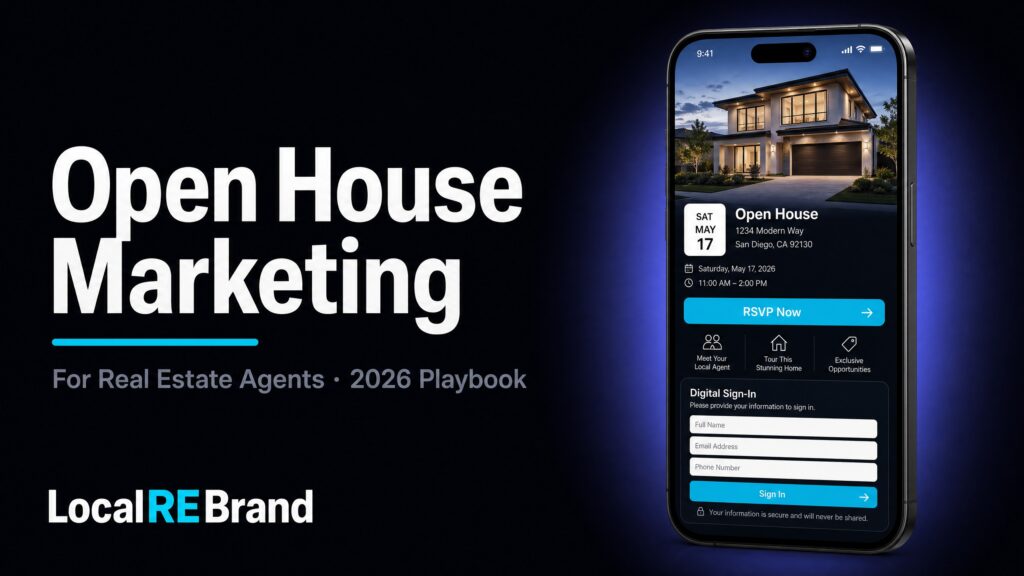
Answer Summary
Open houses matter more in 2026 than they did pre-NAR settlement — because the August 2024 settlement requires buyers to sign written buyer representation agreements before private showings, more unrepresented buyers go to open houses as their first stop. The math: average open house converts at 2.5% to closed sale, but agents who execute a full digital capture + 7-day follow-up sequence convert at 4–8%. The winning system: hyperlocal pre-promotion (online + door-knocking + signage), digital sign-in (paper sheets lose 30–40% of contact data), instant text follow-up within 2 hours, and structured 7-day nurture leading to private showing or buyer consultation.
Key Takeaways
- Average open house converts at 2.5%, with broker open houses at 5% and luxury at 1.8% (Gitnux, 2026).
- Social media-promoted open houses sell 22% faster than non-promoted.
- The 2024 NAR settlement sends more unrepresented buyers to open houses since they can’t easily access private showings without a buyer agreement.
- Digital sign-in tools (Open Home Pro, Curb Hero, Spacio, Harvast) prevent the 30–40% data loss of paper sheets.
- A 20-visitor open house converts to roughly 1 client when run with strong capture + follow-up: 85% to contacts (17), 35% respond (6), 25% appointments (~2), 40% close (1).
- Follow-up must start within 2 hours of the open house ending for highest conversion.
Why Open Houses Still Matter in 2026
A few years ago, open houses looked like they were on the way out. Then the NAR settlement happened.
As of August 2024, buyers must sign a written buyer representation agreement before being shown a property privately by an agent. This created friction in private showings — and pushed more unrepresented buyers toward open houses as their first, low-commitment way to physically tour homes.
The result: open houses in 2026 are seeing higher unrepresented-buyer traffic than in any year since 2010. For agents who treat open houses as a buyer-lead-generation channel rather than just a seller service, this is one of the biggest market shifts of the decade.
This pillar is the full open house system: pre-promotion, execution, capture, follow-up, and the numbers that prove the channel.
Open House Math: What the Numbers Actually Show
The honest conversion math for a well-run open house:
- 15–30 visitors per open house (varies by market, price, marketing)
- 85% capture rate with digital sign-in (12–25 contacts)
- 35% response rate to first follow-up (4–9 responsive contacts)
- 25% book a buyer consultation or private showing (1–2 appointments)
- 40% close rate on serious buyer appointments (~1 closing per 1–2 open houses)
For most agents, two open houses per month = roughly one new client every 1–2 months from open houses. Combined with the listing-side benefit to the seller (showing the home to live buyers), the channel pays for itself.
The math falls apart when:
– Paper sign-in (loses 30–40% of data to illegible writing)
– No follow-up within 24 hours (response rates drop 80%+)
– Generic “thanks for stopping by” email (doesn’t qualify)
– Single follow-up touchpoint (under-touched leads don’t convert)
The system, executed properly, produces the math. Skipping any step kills it.
Pre-Open-House Marketing (The Week Before)
Open houses succeed or fail based on traffic. Traffic requires marketing.
The 7-day pre-promotion checklist:
Day -7 (one week out):
– MLS open house entered
– Listing on Zillow, Realtor.com, Redfin, Trulia all flag open house
– Email to your sphere with the open house details (especially if neighborhood-relevant)
– First social media post (Instagram, Facebook, possibly TikTok)
– Door-knock 50–100 neighbors with a flyer
Day -3 (three days out):
– Second social post (different angle — interior photo, neighborhood feature, drone shot)
– Email reminder to sphere
– Add to local community Facebook groups (where allowed)
– Confirm signage strategy
Day -1 (day before):
– Final social post / Story
– Confirm tech (sign-in tablet, mic if doing a tour speech)
– Print backup paper sign-in (only as backup)
– Confirm all signage locations
Day 0 (open house day):
– Day-of social post that morning
– Stories live from the property
– Sign placement at high-visibility intersections 1–2 hours before start
– Open house signs every block radiating out from the property
Sign strategy:
– Branded directional signs at every intersection within 0.5 mile
– Open house signs in the yard
– Balloons (still effective — visual signal at a distance)
– “Refreshments inside” sign if you’re providing food/drink
Full pre-promo strategy in Hyperlocal Open House Promotion: Door-Knocking the 2026 Way.
Open House Day: Execution Playbook
What you do during the open house determines whether the leads you capture convert.
Setup (60 minutes before):
– Lights on, lamps lit (creates warm feeling)
– Soft music in the background
– Temperature comfortable (cool in summer, warm in winter)
– Refreshments out (water, coffee, simple snacks — nothing distracting)
– Sign-in tablet ready and tested
– Marketing materials displayed (listing flyer, neighborhood info, your business card)
– Phone charged, on silent
– Property featured-listing PDFs printed for take-home
During the open house:
- Greet every visitor at the door. Hand them a listing sheet. Walk them to the tablet for sign-in (frame it as “we’re required to know who’s in the home for security”).
- Don’t hover. Let them walk through. Be available for questions.
- Engage strategically. Open-ended questions: “What brings you out today?” “Have you been looking long?”
- Identify the unrepresented. “Are you working with an agent?” If no, this is your lead.
- Note serious interest signs. Multiple rooms revisited, asking about specific features, talking about furniture placement = serious.
- Hand-collect contact info as backup. Even with digital sign-in, ask for a business card or write down a phone number if they seem qualified.
Capture rate goals:
– 80%+ digital sign-in completion
– 100% greeted in person
– 5+ serious conversations
– 2+ clearly identified unrepresented buyers
Digital Sign-In: The Tech Stack
Paper sign-in is dead. The 2026 standard is digital capture via tablet, QR code, or NFC card.
Top digital sign-in apps for real estate (2026):
- Open Home Pro — established, integrates with most CRMs, free + paid tiers
- Curb Hero — 6,000+ CRM integrations, QR code-first design, freemium
- Spacio — automated email follow-up included, paid
- Harvast — free with QR check-in
- Open House Wizard — text and QR-based registration
Setup essentials:
– Tablet at the entry (iPad or Android with a stand)
– QR code printed at door for self-service
– Form fields: name, email, phone (required); agent representation (yes/no); timeline (drop-down); financing status (drop-down)
– Auto-send confirmation text within 60 seconds
– CRM integration so leads flow into your follow-up system
Privacy compliance:
– Clear notice that contact info will be used for follow-up
– Opt-in checkbox for marketing communications (CAN-SPAM compliance)
– Privacy policy linked
Full app comparison in Open House Sign-In Tech: The Real Estate Agent’s Stack.
The 7-Day Follow-Up Sequence
This is where most open houses fail. Capture without follow-up is worthless.
Hour 1 after the open house ends:
Automated text from your CRM:
“Hey [Name], great meeting you at [Address] today! Here’s the listing info: [link]. Let me know if you have any questions — happy to set up a private showing or talk through your timeline. — Jon”
Hour 24 (next morning):
Personal email with photos of the property + neighborhood context + soft offer to talk.
Day 2:
Personal text or call: “Wanted to check in — any thoughts on the home? Happy to answer questions or pull up some comparable properties.”
Day 4:
Email with a relevant content piece (neighborhood guide PDF, buyer process explainer, market update) — value-first, not pitchy.
Day 7:
Personal call. “Wanted to see if you wanted to schedule a buyer consultation or revisit the home. Also wanted to see if any other properties are on your radar I should know about.”
Day 14:
If no response yet, soft check-in via text.
Day 30:
If still no response, move to long-term nurture sequence (monthly newsletter, hyperlocal content).
The data:
Agents who execute the full 7-day sequence convert open house leads at 4–8%. Agents who send one follow-up email and stop convert at 0.5–1.5%. The sequence is the multiplier.
Full sequence in Open House Follow-Up Sequences That Work.
Signage and Branding
Open house signs should look professional and brand-consistent. Most agents use generic plastic stake signs from Office Depot. The ones who stand out have:
- Custom branded signs (vinyl banners, branded H-frame signs)
- Consistent visual identity across all signage
- Clear directional arrows that actually point the right way
- Strategic placement at high-traffic intersections
- Removed within 60 minutes after the open house ends (no abandoned signs)
Sign quantities (varies by neighborhood):
– Suburban: 8–15 directional signs
– Urban: 5–10 directional signs
– Rural: 15–25 directional signs
Sign quality investment: $300–$800 for a full custom set of signs. Lasts 3–5+ years.
Full guide in Open House Signage and Branding Best Practices.
Virtual Open Houses: When They Work
Virtual open houses peaked in 2020–2021 and have since stabilized as a complementary channel rather than primary.
When virtual open houses make sense:
- Luxury properties with out-of-area buyer interest
- Relocation buyers who can’t physically attend
- Listings during weather events that limit in-person turnout
- Pre-launch teaser before a physical open house
- Tertiary markets where in-person traffic is unreliable
When they don’t:
- Standard sub-$1M listings with strong local buyer pool — in-person beats virtual
- Markets with high competition where physical presence creates urgency
Best practices:
- Use Zoom, Google Meet, or Facebook Live (familiar tools)
- Schedule 30–45 minutes
- Pre-promote heavily (most virtual opens fail on traffic)
- Walk the property camera-in-hand, narrate
- Take questions in chat live
- Record and repurpose as a video listing tour
Full guidance in Virtual Open Houses: When They Work (And When They Don’t).
The Neighborhood Preview Open House
A neighborhood preview open house is a variation of the standard open house: instead of just showing one home, you give visitors context on the neighborhood, comparable properties, and market trends.
The structure:
- Standard open house at one home
- Tabletop displays of recent neighborhood sales
- Printed neighborhood market report
- Optional: walking tour of nearby points of interest
- Optional: short presentation on neighborhood market trends
Why it works:
- Higher value to visitors (they leave knowing more than just the one listing)
- Better at qualifying buyers (engages them in conversation about the market)
- Position you as the neighborhood expert (not just the listing agent)
- Converts open house visitors who weren’t sold on this specific home but liked the neighborhood
Full strategy in The Neighborhood Preview Open House Strategy.
Open House Marketing for a Slow Listing
When a listing has been on the market for 30+ days without an offer, the open house strategy shifts:
The objective: Generate enough fresh attention to attract a serious buyer — or generate enough buyer feedback to inform a price adjustment.
The tactics:
- Run an open house every 2–3 weekends (not just one)
- Promote heavily, including paid social ads ($50–$150 per event)
- Use the events to gather honest buyer feedback (“What stopped you from making an offer?”)
- Document feedback systematically to share with the seller
- Frame each open house as a tactical reset, not a Hail Mary
The seller conversation:
If multiple open houses produce traffic but no offers, the data tells you the price (or something physical about the property) is the issue. Use the open house feedback to have an evidence-based pricing conversation with the seller — not a guessing-game.
Full strategy in Open House Marketing Calendar for a Slow Listing.
Open House Lead Conversion Stats
The conversion math that every agent should know:
| Stage | Typical rate |
|---|---|
| Open house visitor to digital sign-in | 80–90% |
| Sign-in to first response | 30–40% |
| First response to consultation booking | 25% |
| Consultation to engagement | 40–50% |
| Engagement to closed deal | 60–80% |
| Total: visitor to closed deal | 2–4% per open house |
Multiply by your open house volume:
– 1 open house/month × 20 visitors × 3% = 0.6 closings/year
– 2 open houses/month × 25 visitors × 3% = 18 closings/year
– 4 open houses/month × 25 visitors × 3% = 36 closings/year
Open houses scale. The agents who run them weekly, with strong systems, can generate 20+ buyer-side closings/year from open houses alone.
Full data analysis in Open House Lead Conversion Stats Every Real Estate Agent Should Know.
The Open House Workflow That Scales
Here’s the end-to-end workflow that makes open houses sustainable as a recurring channel:
Monday before:
– Choose the listing for the upcoming weekend
– Confirm with seller
– Enter open house in MLS
– Schedule social media pre-promo
– Order door-knocking materials
Tuesday-Wednesday:
– Door-knock surrounding 50–100 homes with flyers
– Send first social posts
– Email sphere
Thursday-Friday:
– Second social posts
– Final sphere email
– Confirm signage logistics
– Test tech setup
Saturday or Sunday (open house day):
– Setup 60 min before
– Run open house 2–3 hours
– Capture every visitor digitally
– Brief notes on every serious conversation
Same day, within 2 hours:
– Automated text to every visitor
– Personal text to top 3 serious leads
Next 7 days:
– Execute 7-day follow-up sequence
Monthly:
– Open house performance review
– Lead-source attribution check
– Adjust marketing mix based on what’s working
Total time per open house: ~6–8 hours including pre-promo, event, and follow-up. Scales nicely with experience.
Frequently Asked Questions
Q: How often should I host open houses?
For active listings: every 1–2 weekends until sold. For lead generation, you can do “broker open houses” or partner with other agents to host one of theirs in exchange for a percentage of any captured leads.
Q: Do open houses actually sell homes?
Some do, most don’t directly. The real value of open houses for the seller is exposure + buyer feedback; the real value for the agent is buyer lead generation. Frame the conversation with sellers honestly — open houses are buyer-funnel events, not magic-sale events.
Q: What’s the right open house duration?
2–3 hours is the sweet spot. Less and you miss traffic; more and you burn out and lose energy on visitor #20.
Q: Should I serve food at an open house?
Light refreshments: yes (water, coffee, cookies). Full catering: only for luxury listings or special events. Heavy food can distract from the property and create perceived obligation.
Q: Should I host open houses for someone else’s listing?
Yes, sometimes. With permission from the listing agent, hosting their open house generates leads for you while marketing their listing. Common arrangement: you provide hosting in exchange for capturing buyer leads (which the listing agent doesn’t typically pursue as buyer-side opportunities).
Q: How do I handle no-shows at an open house?
Even slow open houses are useful for visibility, but if you consistently have low traffic, audit your pre-promo and signage. Often the problem is upstream (not enough marketing) rather than the event itself.
Q: What about safety?
Always have a backup person present, share your location with someone, document who’s in the home (digital sign-in helps), and trust your instincts. Real estate safety has become a much bigger conversation post-Beverly Carter case — take it seriously.
What to Do This Week
If you only do five things this week:
- Choose a digital sign-in app. Set up an account this week if you don’t have one.
- Document your 7-day follow-up sequence in your CRM, with templates.
- Build your sign inventory. Branded, professional, durable.
- Plan next month’s open house schedule. 2–4 events depending on listings + bandwidth.
- Audit your last 10 open house visitors. How many got proper follow-up? Fix the gaps.
For a free 30-minute open house strategy session, book here.
Jon Smith is a 20+ year SEO veteran specializing in real estate agent local marketing and lead generation. He has helped hundreds of agents systematize open houses as recurring lead channels. Connect on LinkedIn or read more on LocalReBrand.com.
Sources & further reading:
- 120+ Open House Statistics 2026 Data Report — Gitnux
- Complete Guide to Open Houses That Actually Work 2026 — Neuhaus
- How To Convert Open House Visitors Into Clients — RLTRsync
- 26 Open House Ideas That Actually Get You Leads 2026 — The Close
- Real Estate Open House Lead Capture Ideas 2026 — Wave Connect
- Automate Open House Follow-Up — US Tech Automations
- Spacio — Automated Paperless Open House App