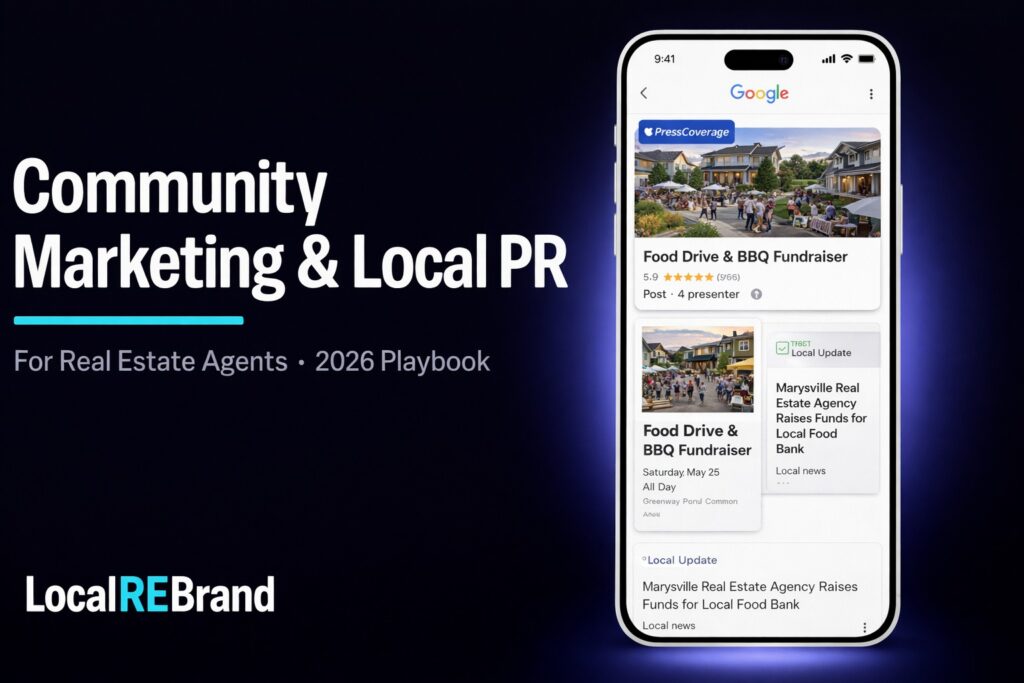
Answer Summary
Community marketing and local PR are the slow-cooking ingredients that convert a “marketing-driven” real estate practice into a “trust-driven” one. The 2026 strategy: hyperlocal focus (own one specific story or trend in your market rather than broad housing news), systematic outreach to local journalists and podcasts, sponsorship of community events and causes that align with your niche, speaking at local events, and authentic community involvement that produces both backlinks and brand recognition. Hyper-local PR routinely outperforms national-scale PR for individual agents because trust compounds at the local level.
Key Takeaways
- Hyperlocal PR focus outperforms national for individual agents because trust compounds at the local level (Green Flag Digital, 2026).
- Local press mentions are some of the highest-authority backlinks available — and they compound brand recognition with neighborhoods you serve.
- Podcast guesting takes 60 minutes total per appearance (30–45 min recording + setup) and produces ongoing referral and authority benefits.
- The community PR stack: local press, podcasts, charity sponsorships, school programs, speaking opportunities, magazine features.
- Industry-wide trend in 2026: real estate coverage is shaped less by housing news alone, more by macro signals (economy, demographics, lifestyle). Position yourself as the local interpreter.
- Real estate agents who consistently invest in community presence for 3+ years dominate sphere referral patterns.
Why Community PR Beats Paid Marketing Over Time
Three years ago I worked with a Denver agent who had spent five years quietly sponsoring local school PTOs, attending neighborhood association meetings, and writing the occasional op-ed for a local lifestyle magazine. She didn’t run Facebook ads. She rarely posted on social media.
She closed 28 transactions that year. Average commission: $11,200. Zero paid lead spend.
When I asked where her leads came from, she said: “People in the neighborhood know me. They mention me to their friends. By the time someone calls me, they’ve already decided to work with me.”
That’s what community marketing produces. It’s slow, unmeasurable in the short term, and almost invisible to competitors. After three years it becomes a moat that no marketing budget can compete with.
This pillar is the system: local PR, community involvement, speaking, podcasts, charity, and the ongoing presence that compounds.
The 6 Levers of Community Marketing
The components of a real community marketing program:
1. Local press coverage. Earned media in local news, business journals, lifestyle magazines.
2. Podcast guesting. Both real estate industry podcasts and local community podcasts.
3. Charity and cause sponsorship. Causes that align with your community and your values.
4. Speaking and education. Workshops, panels, community meetings, school events.
5. School and youth involvement. PTO sponsorships, school events, mentorship programs.
6. Civic and association involvement. Chamber, civic clubs, neighborhood associations, professional groups.
Most agents do one or two sporadically. The agents who win at community marketing do all six consistently for years.
Getting Local Press Coverage in 2026
Local press is the highest-authority backlink + brand exposure combination available to real estate agents.
What journalists actually need:
- Quick, specific, named expert sources
- Original data and observations from the market
- Quotable, declarative statements
- Reliable response time (often under 30 minutes)
- Topical relevance to current news cycles
How to become a go-to expert source:
1. Build your reporter list. Identify 5–10 reporters in your market who cover real estate, housing, business, or local development. Use LinkedIn, Twitter/X, the masthead of each publication, and “Real Estate” beat reporter searches.
2. Follow and engage authentically. Engage with their content on social media for 30–60 days before pitching anything. Build recognition.
3. Send a brief, useful pitch.
“Hi [Name], I cover residential real estate in [neighborhoods]. I’m seeing [specific market shift / data point]. If you ever need a source for [topic area], happy to be quick to respond. Numbers and quotes ready. — Jon”
Short, specific, no hard ask, contact info clear.
4. Subscribe to HARO and Qwoted. Free journalist source-request platforms. Subscribe to real estate, housing, business, finance, and local categories. Respond within 30 minutes to relevant queries with specific quotes ready to publish.
5. Create proactive newsworthy moments.
– Monthly market reports with proprietary data
– Year-end real estate forecasts
– NAR settlement implications interpretation
– Seasonal market commentary
– Major local development reactions
6. Be the easy yes. Always respond. Always with usable quotes. Always with a sourced number or specific observation. Always with availability for follow-up.
A consistent agent who pitches monthly and responds quickly typically lands 4–10 local press mentions per year. Each mention compounds.
Full press strategy in How Real Estate Agents Get Local Press Coverage in 2026.
The Hyperlocal Press Release: When and How to Send One
Press releases are overused and over-mocked, but used sparingly for legitimate news, they still work in 2026.
When to send a press release:
- Major milestone (100th transaction, 25th year in business, etc.)
- Significant community involvement (large sponsorship, charity drive total)
- Award or recognition received
- Significant market data or research you’re publishing
- New office opening, team expansion
- Hosting a notable community event
When not to send a press release:
- New listing (use the MLS and your social channels)
- Minor business updates (your blog covers these)
- Anything that isn’t actually news to anyone outside your business
Press release format:
- Headline: 8–12 words, news-driven (not promotional)
- Subhead: 1–2 sentences with the angle
- Lead: who, what, when, where, why, in the first paragraph
- Body: details, context, supporting quotes
- Boilerplate: brief business description, founded date, key stats
- Contact: name, phone, email, link
Distribution:
- Direct to your reporter list (highest hit rate)
- HARO or PR Newswire (lower hit rate, broader reach)
- Local Chamber of Commerce newsletter
- Industry trade publications
A great press release that lands one quality local mention is worth 50 sent and ignored. Quality of pitch, list of recipients, and timing all matter.
Full guide in The Hyperlocal Press Release: When and How to Send One.
Podcast Tour Strategy
Podcast guesting is one of the most leveraged content moves in 2026 for real estate agents. A single 45-minute podcast appearance produces:
- 1–2 hours of audio content with your voice and brand
- A backlink from the podcast’s website
- Distribution to the podcast’s existing audience
- A clip you can use in your own social distribution
- Authority signal (you’re the kind of person who gets booked on podcasts)
- Potential direct leads from listeners
The podcast guest strategy:
Layer 1: Real estate industry podcasts.
– NAR REALTOR® News, Change Agents Podcast
– Real Estate Rockstars (Pat Hiban)
– Stay Paid
– The Tom Ferry Podcast Experience
– Real Estate Coaching Radio
– Top Agents Playbook
These appearances reach other agents — useful for agent-to-agent referrals and industry visibility.
Layer 2: Local community podcasts.
– Most markets have 5–15 local lifestyle, business, or community podcasts
– These reach your actual prospective clients
– Often easier to get booked on (lower competition than industry podcasts)
– Strongest direct lead-generation potential
Layer 3: Adjacent vertical podcasts.
– Personal finance podcasts (your topic: home buying decisions)
– Family/parenting podcasts (your topic: relocating with kids)
– Investment podcasts (your topic: real estate as portfolio strategy)
– Local business podcasts (your topic: building a service business)
How to get booked:
- Listen to 5–10 episodes of the target podcast
- Identify a topic gap or angle you can fill
- Pitch with 3 specific topic ideas + your credentials + a 1-line on why now
- Make it easy: provide bio, headshot, 3 sample questions
- Be a great guest (specific, story-driven, gives the host the easy ending)
A consistent agent who pitches 10 podcasts a month typically lands 2–4 placements monthly. Over a year, that’s 25–50 podcast appearances and the compounding authority effect.
Full strategy in Real Estate Podcast Tour: How to Get Booked on Local Shows.
Charity and Cause Sponsorships
Beyond backlinks, charity sponsorships build community presence and personal brand alignment with causes that matter in your market.
The strategic framework:
1. Choose causes that align with your niche.
- Family-focused agent → schools, youth sports, family services
- Luxury agent → arts, cultural institutions, hospital foundations
- Investor-focused → small business incubators, financial education programs
- Relocation-focused → community welcome programs
2. Pick depth over breadth.
Five sustained partnerships over 5 years > 50 one-off donations.
3. Show up beyond the check.
Volunteer at the event. Bring your team. Show up to the gala. Post the moment authentically (not promotionally).
4. Document and share.
Each sponsorship is a content moment: blog post, social, newsletter. Frame it as the cause’s story, not yours.
5. Track the relationships.
Many of your closest community relationships will come through cause involvement. Track who you meet and follow up.
Full strategy in The Local Charity Strategy That Builds an Agent’s Brand.
Hosting Community Events
Sponsoring is one thing. Hosting your own community event is another — higher effort, much higher leverage.
Event types that work for real estate agents:
- Annual client appreciation event. Pumpkin patch day, holiday lights tour, summer pool party.
- Educational events. “First-Time Homebuyer Workshop,” “Real Estate Investing 101,” “Selling in [Year]” — community education, not sales pitch.
- Charity events. You host, proceeds benefit a local cause. Community goodwill + brand exposure + content moment.
- Neighborhood-specific events. Sub-neighborhood block parties, neighborhood association co-hosted events, hyperlocal welcome events for new residents.
Event playbook:
- Pick a date 60–90 days out
- Choose a venue (your office, a partner location, a public park)
- Invitation: email + direct mail + social
- Day-of logistics: catering, signage, photographer
- Follow-up: thank-you emails, photo recap, content asset for the year
A well-hosted community event delivers:
– 30–100 direct touchpoints with prospective clients and sphere
– A content moment (photos, video, blog post)
– Local backlinks (if the event gets press)
– Referral conversations that wouldn’t have happened otherwise
Full event playbook in How to Host a Community Event That Brings in Real Estate Leads.
Speaking at Local Events
Speaking — even short talks — establishes you as the expert in front of qualified audiences.
Speaking opportunities to pursue:
- Chamber of Commerce events
- Local business and trade association meetings
- Civic club lunches (Rotary, Kiwanis, Lions Club)
- HOA / neighborhood association meetings
- Public library “How to Buy Your First Home” workshops
- Continuing education for lenders, attorneys, accountants
- High school career days
- College career fairs
- Industry conferences (real estate, mortgage, financial planning)
- Community college extension programs
How to land speaking opportunities:
- Identify the organizer / program chair for each target organization
- Pitch 2–3 specific talk topics you’d be willing to give
- Provide a one-page speaker sheet: bio, headshot, talk topics, audience benefits, past speaking experience
- Be flexible on date and format
Talk topics that work for real estate agents:
- “Buying a Home in [Market]: What’s Changed Post-NAR Settlement”
- “The 2026 Real Estate Outlook for [Market]”
- “How to Build a Local Business: My 20-Year Story” (for business audiences)
- “Real Estate as an Investment: The 5-Year Outlook”
- “Selling Your Home: What to Do First”
A speaking presence of 4–8 events per year creates compounding local authority. Each talk is also a video asset, a blog post, a social media moment.
Full strategy in Speaking at Local Events: A Booking and Pitching Guide.
School Sponsorships: The Quiet Goldmine
School sponsorships are underused by real estate agents. They produce:
- Direct backlinks (school websites typically list sponsors)
- Community visibility with the parent demographic (often the buying/selling demographic)
- Authentic positioning (“you support our schools”)
- Long-term relationships with parent networks
Sponsorship types:
- School year sponsorship (named donation to PTO)
- Specific event sponsorship (back-to-school night, spring fair, athletic banquets)
- Athletic program sponsorship (jerseys, scoreboards, field signage)
- Educational program sponsorship (specific class supplies, reading programs)
- Senior class sponsorship (graduation events, senior trip support)
Cost benchmarks: $200–$2,500 per school per year, depending on level.
Selection criteria: sponsor schools in your farm areas. Sponsor multiple grade levels if budget allows (elementary parents become middle school parents, etc.).
Full strategy in School Sponsorships: The Quiet Goldmine for Real Estate Agents.
Getting Featured in Local Magazines
Local lifestyle, business, and home/garden magazines are some of the most under-leveraged PR opportunities for real estate agents.
Magazine types to target:
- City-specific lifestyle magazines (5280 in Denver, Texas Monthly, San Francisco Magazine)
- Neighborhood magazines (often hyperlocal, looking for content)
- Business journals (Denver Business Journal, etc.)
- Home and garden publications
- Industry trade magazines (real estate, mortgage)
Pitch angles:
- Local real estate market commentary
- Profile features (“Meet [Agent]: How They Built Their Business”)
- Expert source quotes
- Original data and analysis
- Niche-specific features (luxury, relocation, investment)
How to land features:
- Read 3–5 issues of each target magazine
- Identify the writers who cover real estate or business
- Pitch them via email or LinkedIn
- Follow up if no response in 2 weeks
- Make yourself easy to work with (fast response, quality quotes)
A local magazine feature can drive 20–50 inbound inquiries over a few months. Plus the print + digital presence compounds your authority.
Full strategy in How to Get Featured in Local Magazines as a Real Estate Agent.
Real Estate Agents and Local Politics
Tread carefully here. Local political involvement can build presence — or alienate large portions of your prospective market.
The framework I use with clients:
- Civic involvement (zoning, planning, housing policy) is generally safe. You’re directly affected as a real estate professional; clients understand and respect informed engagement.
- Partisan political content on social media is risky. Real estate is YMYL — your job is being a trusted financial advisor, not a political commentator. Mixing the two costs you market share.
- Charitable causes are usually safe. Especially when framed around community benefit, not policy.
- Local elections (mayor, city council) — case by case. Many agents safely participate in local elections; the line is when you become identified primarily by political alignment rather than by your professional work.
The decision is yours. Be aware of the trade-offs.
Full discussion in Real Estate Agents and Local Politics: Boundaries and Branding.
Measuring Community Marketing ROI
Community marketing is harder to measure than other channels but not impossible:
Activity metrics:
– Press mentions earned (monthly count, cumulative)
– Podcast appearances
– Speaking engagements
– Sponsorships active
– Community events hosted or attended
Outcome metrics:
– Inbound leads mentioning community involvement
– Brand search increases (your name + your market)
– Direct website traffic growth
– Referrals from community contacts
– Closed deals attributed to community connections
The compounding signal: When 30%+ of new leads mention having heard of you “from someone” or “in the community” before the first call, your community marketing is working.
Track quarterly. The agents who actually measure see results in months 6–12 and dominate by year 3.
The 30/60/90 Community Marketing Plan
Days 1–30: Foundation.
– Build reporter list (5–10 local journalists)
– Subscribe to HARO and Qwoted
– Identify 5 podcast targets (mix of industry and local)
– Choose 1–2 charity causes to commit to deeply
– Map next 12 months of community events to attend
Days 31–60: Activation.
– Send first journalist pitches
– Pitch first 5 podcasts
– Confirm first charity sponsorship
– Attend 2 local events in person
– Reach out for 1 speaking opportunity
Days 61–90: Cadence.
– First podcast appearance (and content asset from it)
– Pitch 5 more journalists, 5 more podcasts
– Confirm second charity sponsorship
– Host your first community event (small, low-stakes start)
– First press monitoring report
After 90 days you have a community marketing engine in motion. Months 4–12 are about cadence and compounding.
Frequently Asked Questions
Q: How long until community marketing produces business?
12–24 months for substantial impact. First wins (a press mention, a podcast appearance, a community contact who becomes a client) can come in months 3–6. The compounding becomes obvious in years 2–3.
Q: How much should I budget for community marketing annually?
$5,000–$25,000/year is typical for serious community marketing programs. Bigger end for teams or luxury agents.
Q: Should I hire a PR agency?
For most agents, no — the cost is hard to justify against DIY ROI. For luxury agents or teams with $5K+/month marketing budgets, a local-focused PR agency can accelerate results. For the majority of agents, the playbook in this article executed in-house outperforms most paid PR services.
Q: What’s the single highest-ROI community marketing move?
Subscribing to HARO and Qwoted, responding to journalist queries within 30 minutes with specific quotes. Free. Produces 3–8 quality press mentions per year for diligent responders.
Q: Should I focus on industry podcasts or local community podcasts?
Both, with local community podcasts producing more direct leads and industry podcasts producing more agent-to-agent referrals and authority signals.
Q: How do I avoid getting “rejected” from a sponsorship that doesn’t reciprocate?
Pick organizations that are genuinely organized (websites, regular events, real audiences). Avoid one-person operations or vaguely-defined “we’ll mention you somewhere” arrangements. Get the sponsorship deliverables in writing.
Q: How do I balance personal political content with my business presence?
Default: keep partisan political content off your business channels. Save it for personal accounts with limited business visibility. Real estate is YMYL — clients are trusting you with major financial decisions and prefer to focus on that.
What to Do This Week
If you only do five things this week:
- Build your local reporter list. 5–10 names, beats, contact info.
- Subscribe to HARO and Qwoted. Set up real estate, housing, business categories.
- Identify 3 podcasts to pitch. One industry, one local community, one adjacent vertical.
- Pick your charitable cause for 2026. Commit to one organization deeply rather than several shallowly.
- Schedule one community event to attend in the next 30 days. Show up. Meet people. Build presence.
For a free 30-minute community marketing audit, book here.
Jon Smith is a 20+ year SEO veteran specializing in real estate agent local presence and community marketing. He has helped hundreds of agents build community-driven practices across North America. Connect on LinkedIn or read more on LocalReBrand.com.
Sources & further reading:
- Real Estate Digital PR Examples 2026 — Green Flag Digital
- 7 Real Estate Public Relations Strategies — The Close
- The 11 Best Real Estate Podcasts in 2026 — HousingWire
- Icons of Real Estate Podcast Network — Icons of Real Estate
- Real Estate’s Power Players Take the Mic — NAR
- 15 Best Real Estate Podcasts for Agents 2026 — Luxury Presence
- Best Real Estate PR Agencies 2026 — AMW