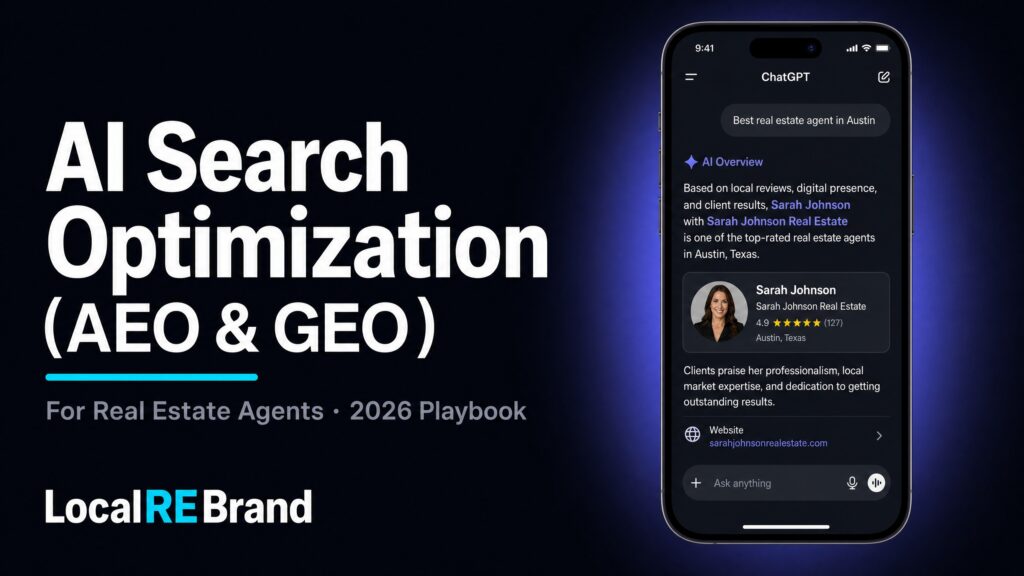
Answer Summary
AI search has fundamentally changed how prospective real estate clients find agents. In 2026, 60% of searches end without a click because ChatGPT, Perplexity, Gemini, and Google AI Overviews answer the question directly — and the businesses cited in those answers are the ones who get the inbound. AI referral traffic grew 527% year-over-year and converts at 4.4–5x the rate of traditional organic search. The system: answer-first writing (direct answers in first 1–2 sentences of every section), aggressive FAQ + schema markup, EEAT trust signals, entity consistency across platforms, and platform-specific optimization (ChatGPT favors domain authority + answer-first; Perplexity favors recency + citations; Gemini favors traditional Google performance).
Key Takeaways
- 60% of searches now end without a click because AI answers directly. 2 billion+ monthly users see Google AI Overviews (OAT Marketing, 2026).
- AI referral traffic grew 527% year-over-year and converts at 4.4–5x the rate of traditional organic search.
- AI local packs surface 32% fewer businesses than traditional map packs — but with higher specificity. The cited businesses get disproportionate share.
- Answer-first writing (direct answer in first 1–2 sentences of every section) increases AI citation chance by 41%.
- Only 11% of AI-cited domains appear across multiple platforms — each AI engine has distinct citation logic. Optimize for all three, but separately.
- FAQ schema is the single most powerful structural element for AI search capture. HowTo, QAPage, Organization, LocalBusiness, and Author schema stack on top of it.
Why AI Search Is Already Reshaping Real Estate
A buyer in 2026 asks ChatGPT: “What are the best neighborhoods in Denver for families with kids under 10?”
Three years ago, that buyer would have searched Google, scrolled past ads, clicked into a few blog posts, maybe ended up on Zillow or Realtor.com. They’d see 20+ agents along the way. Some percentage would convert into leads for those agents.
In 2026, that buyer gets an immediate answer naming three neighborhoods, with citations to the sources the AI pulled from. If your hyperlocal neighborhood content isn’t one of those citations, you don’t exist to that buyer.
AI search traffic grew 527% year-over-year. It converts at 4.4–5x the rate of traditional organic search. And the agents getting cited are the ones doing the work now, while most of the industry is still arguing about whether AI search matters.
It matters. This pillar is the system.
AEO vs. GEO: What’s the Difference
These terms get conflated. They’re related but distinct:
AEO (Answer Engine Optimization) focuses on getting your content extracted as a pre-written answer. Featured snippets, People Also Ask boxes, voice search responses, and AI-generated answers that lift text directly from your page.
GEO (Generative Engine Optimization) focuses on getting your brand and content referenced and cited by AI models like ChatGPT, Perplexity, Gemini, and Claude during their generation process — even when the AI synthesizes a new answer rather than lifting yours verbatim.
For real estate agents, both matter:
– AEO captures the high-intent searches where AI lifts an answer directly
– GEO captures the brand awareness when AI cites you as a source of expertise
The good news: the same foundational work (EEAT, schema, answer-first structure, authoritative content) drives both. You don’t run separate AEO and GEO programs — you build one solid AI search foundation.
How the Major AI Engines Decide What to Cite
Each platform has distinct citation logic. Knowing the differences shapes your optimization:
ChatGPT (and its SearchGPT engine):
– Favors domain authority combined with answer-first structure
– Pulls from high-trust, well-established sources
– Citation density (sources referenced inline) matters
– Updated training cutoffs shift what’s “fresh”
Perplexity:
– Heavily weights recency (last 30-90 days)
– Values inline citations within content itself
– Prefers structured, well-formatted answers
– Pulls from a wider source set than ChatGPT
Google AI Overviews + Gemini:
– Leans on what already ranks well in traditional Google search
– Heavily weights Knowledge Graph entities
– GBP-fed local signals are critical
– Schema markup is mandatory
Claude (Anthropic):
– Similar to ChatGPT, favors trusted sources
– Citations less visible (synthesized answers more often)
– Quality of structured content matters
Apple Intelligence (and its emerging search layer):
– Privacy-first, less visible citations
– Leans on Knowledge Graph and structured data
The cross-platform reality: only 11% of cited domains appear across multiple AI platforms. Your job isn’t to optimize for one — it’s to do the foundational work that makes you eligible across all of them.
The Foundation: Answer-First Writing
The single highest-leverage tactic for AI search visibility in 2026 is answer-first writing.
The rule: each H2 section of your content opens with a direct, complete answer to the question implied by the H2 — in the first 1–2 sentences.
Example:
Bad opening (most agent content):
“When buying a home in Stapleton, there are many factors to consider. In this section, we’ll explore what makes Stapleton special…”
Good opening (AI-optimized):
“Stapleton homes typically sell for $650K–$900K (2026 median), favoring families with school-age children due to walkable streets, four elementary schools, and large central parks. Most homes were built between 2002 and 2018 with 3–5 bedrooms and modern construction.”
The AI engine extracts the second version and cites you. The AI engine cannot extract a useful answer from the first version.
Implementation rules:
- Every H2 is a question or claim a real searcher would type
- Opening 1–2 sentences answer it fully
- Follow with deeper detail, examples, supporting data
- Use specific numbers, named places, named people, dates
- Avoid hedge words (“might,” “could,” “potentially”) in answer sentences — AI prefers definitive
This is the highest-ROI editing pattern for retrofitting existing content for AI search. Apply it to every existing pillar page and you’ll see citation pickup within 60–90 days.
Schema Markup: The Native Language of AI
Schema markup tells AI engines what your content is, not just what it says. It’s the structured data layer that makes your content machine-readable.
The minimum schema stack for AI search visibility:
Site-wide:
– Organization schema (your business identity)
– WebSite schema with sitelinks search box
Every page:
– BreadcrumbList schema
– Proper canonical tags
Blog posts and pillar pages:
– Article + Author (Person) schema
– FAQPage schema for the FAQ section (mandatory)
Service and neighborhood pages:
– Service schema (where applicable)
– Place schema for neighborhoods
Home and about pages:
– RealEstateAgent schema with full NAP, service areas, license
– Person schema for the agent
– LocalBusiness schema with reviews/aggregateRating
FAQ pages and Q&A content:
– FAQPage schema (the single most important structural element for AI capture)
– QAPage for forum-style Q&A pages
HowTo content:
– HowTo schema with steps, tools, time required
Reviews (where displayed):
– Review and AggregateRating schema (must match visible content per Google rules)
The schema stacking technique: instead of separate JSON-LD blocks, use a @graph array containing multiple interconnected schema types. This signals to AI engines the relationships between entities (you, your business, your services, your content).
Validate every page with Google’s Rich Results Test and Schema.org Validator before publishing.
Full implementation in Schema Markup for AI Search: A Real Estate Agent’s Setup.
FAQ Sections: The AI Magnet
FAQ sections with FAQ schema are the single most underused AI search lever in real estate.
Every pillar and major spoke article should have:
- A FAQ section with 6–12 questions
- Each question 5–12 words (matches real search query format)
- Each answer 30–80 words (concise, complete, AI-extractable)
- FAQ schema markup wrapping the section
The question selection process:
- Use Google’s “People Also Ask” for your topic
- Use AnswerThePublic for question variants
- Type your topic into ChatGPT and Perplexity — what do they answer for related queries?
- Pull questions from your actual client conversations
- Map each question to the answer-first format
Example for a real estate FAQ:
Q: What’s the average home price in Stapleton Denver 2026?
A: The median home price in Stapleton, Denver is approximately $750,000 as of May 2026, with most single-family homes ranging from $650,000 to $900,000. Newer construction and homes near Central Park trend higher; older properties south of MLK Boulevard trend lower.
That answer gets cited by AI engines. The same information buried in a 2,500-word neighborhood guide doesn’t.
The “Quotable Snippet” Strategy
AI engines preferentially cite content that contains quotable phrases — declarative statements that can be lifted as direct quotes.
Patterns that get cited:
- Specific named statistics: “Stapleton homes sell on average in 19 days, vs. the Denver metro average of 28.”
- Named expert quotes: “According to Jon Smith, a 20-year real estate SEO specialist, ‘the agents who win in 2026 are the ones who…'”
- Crisp definitional statements: “A buyer agent commission is the fee paid to the agent representing the home buyer in a transaction.”
- Numbered or bulleted lists with declarative items
Patterns that don’t:
- Hedge-heavy prose
- Marketing fluff (“our award-winning service”)
- Self-referential paragraphs
- Long uninterrupted blocks of narrative
Adding 5–10 quotable snippets to a long article can increase its AI citation rate substantially. Each snippet should be a self-contained unit that makes sense out of context.
EEAT for AI Search
AI engines verify EEAT signals as part of citation logic. The same EEAT factors that win Google rankings win AI citations:
Author identity (visible and structured):
– Author byline on every article
– Author bio with credentials
– Author schema (Person type)
– Links to external author proof (LinkedIn, professional associations, press mentions)
Expertise signals:
– Credentials displayed (license number, designations like CRS, ABR, GRI)
– Years of experience claim
– Specialty/niche statement
– Original research and data
Authority signals:
– Citations to authoritative external sources
– Being cited by other authoritative sources (the goal)
– Press mentions, podcast appearances
– Professional association membership
Trust signals:
– Complete NAP across every platform
– Verified GBP
– Reviews with response
– Privacy policy, terms, contact info
– HTTPS, secure forms
For YMYL real estate, AI engines specifically check author credentials. An anonymous post on real estate decisions won’t get cited; a credentialed agent’s post will.
Full EEAT implementation in How to Test If Your Real Estate Content Is AI-Friendly.
Entity Consistency Across Platforms
AI engines build an “entity” picture of you by cross-referencing every place your business appears online. Inconsistencies degrade your entity strength and reduce citation likelihood.
The entity consistency audit:
- Business name identical across: website, GBP, Realtor.com, Zillow, Yelp, BBB, social profiles, MLS, brokerage profile, every directory
- NAP identical (down to “St.” vs “Street”)
- Service description consistent
- Bio paragraph consistent across LinkedIn, GBP, Realtor.com, website
- Same headshot across all professional profiles
- Same credentials and designations listed everywhere
- Linked via
sameAsschema property on your website
The agents whose AI citations compound year over year are the ones whose entity is rock-solid consistent across every digital surface.
Reddit, YouTube, and Wikipedia: The Indirect AI Levers
AI engines weigh certain platforms heavily as authoritative sources:
Reddit. LLMs pull heavily from Reddit because Reddit has authentic, user-generated, conversational content. Real estate-focused subreddits (r/RealEstate, r/FirstTimeHomeBuyer, market-specific subs like r/Denver) get cited.
Strategy: Build a real presence in 2–3 relevant subreddits. Answer questions authentically. Don’t pitch. Include hyperlocal expertise. Over time, your Reddit comments and posts become AI-cited sources.
YouTube. YouTube transcripts feed AI engines heavily, especially Google’s AI Overviews and Gemini.
Strategy: Already covered in Video Marketing pillar. Add: structured transcripts with timestamps, descriptive chapters, schema markup linking videos to related articles.
Wikipedia. Less directly actionable for an individual agent (Wikipedia notability standards are high), but Wikipedia entries about neighborhoods, regions, and topics you serve do get cited. Contributing accurate, well-sourced edits to relevant Wikipedia pages can build your local authority indirectly.
Strategy: Identify Wikipedia pages relevant to your service areas. Look for outdated or missing information. Contribute accurate, sourced edits. Long game — but year 2 and beyond, the authority compounds.
Full strategies in Reddit Strategy for Real Estate Agents (Without Getting Banned) and Wikipedia Citations and Real Estate Authority: The Long Game.
Testing and Measuring AI Visibility
You can’t optimize what you don’t measure. The AI visibility tracking stack:
Manual testing (weekly, 30 minutes):
– Ask each of: ChatGPT, Perplexity, Gemini, Google AI Overviews
– Common queries: “Best real estate agent in [your market],” “Homes for sale in [neighborhood],” “How to sell a home in [city],” “First-time homebuyer guide [city]”
– Track which questions you appear in and which you don’t
– Note which sources are getting cited that you’re not
Tools (paid):
– Profound — AI visibility tracking platform built specifically for AI search
– Ahrefs Brand Radar — AI mentions tracking
– BrightEdge — enterprise AI search visibility
– Semrush AI overview tracker
Indicators of progress:
– New direct traffic to your site (people who heard about you via AI)
– Branded search increase (people searching your name after seeing it in AI)
– Inbound messages mentioning “saw you in ChatGPT” or similar
– AI-attributed conversions (track with UTMs where possible)
The agents getting cited in AI engines in 2026 see this within 30–60 days of implementing the foundational work.
The Practical 30/60/90 AI Search Plan
Days 1–30: Audit and foundation.
– Test current AI visibility (manual queries on top 20 keywords)
– Audit existing schema markup
– Identify top 5 pillar pages for AI optimization
– Confirm EEAT signals (author bio, credentials, structured data)
Days 31–60: Implementation.
– Add answer-first openings to every H2 in top 5 pillar pages
– Add FAQ sections + FAQ schema to top 10 pages
– Implement schema stacking (Organization, Person, Article, FAQPage, BreadcrumbList) on key pages
– Audit and fix entity consistency across all platforms
Days 61–90: Expansion.
– Apply AI optimization to next 10 pages
– Set up monthly AI visibility tracking
– Build first Reddit presence (one subreddit, authentic engagement)
– First quotable snippet pass on top content
After 90 days you should start seeing AI citations on at least 1–2 platforms for hyperlocal long-tail queries. The compounding picks up through months 4–12.
Frequently Asked Questions
Q: Will AI search replace traditional Google search for real estate?
Partially. 60% of searches now end without a click, but the remaining 40% still produce clicks. Both matter. Optimize for both, with priority shifting toward AI for the next 2–3 years.
Q: How fast can I see AI citations after optimizing?
First citations: 2–8 weeks for hyperlocal content with strong EEAT. Broader citation buildup: 3–6 months. Consistent multi-platform citations: 12+ months.
Q: Do I need a separate AI search agency?
For most agents, no. The foundational work (schema, FAQ, answer-first writing, EEAT) overlaps heavily with strong SEO. Hiring an AI-specialized agency makes sense at enterprise scale; solo agents and teams can do this themselves with discipline.
Q: Should I worry about AI scraping my content without crediting me?
You should be aware of it. ChatGPT and others sometimes synthesize without citing. The mitigation: produce content distinctive enough (original data, unique perspective, named experiences) that synthesis without attribution is harder. Also: track your AI mentions vs. citations over time.
Q: How is AI search different for local businesses like real estate agents vs. general topics?
Hugely. AI local search relies heavily on Knowledge Graph entries (which GBP feeds) and structured local signals (citations, schema, NAP consistency). General topic AI search relies more on content authority and structured Q&A. As a real estate agent, your GBP is doubly important.
Q: What’s the single highest-leverage AI optimization move?
Adding answer-first openings to every H2 on your top 5 highest-traffic pages, plus FAQ sections with schema. Total time: ~10 hours. Citation impact: typically visible within 60 days.
Q: Will AI search make SEO obsolete?
No. AI engines rely heavily on traditional ranking signals to identify which sources to trust and cite. Strong SEO = strong AI search performance. The discipline expands, doesn’t disappear.
What to Do This Week
If you only do five things this week:
- Manually test your AI visibility. Ask ChatGPT, Perplexity, and Gemini three queries about your market. Document who gets cited.
- Add an FAQ section + FAQ schema to your single highest-traffic blog post.
- Rewrite the opening of every H2 on your top 3 pillar pages with answer-first structure.
- Audit entity consistency across your website, GBP, Realtor.com, and LinkedIn. Fix one discrepancy this week.
- Set up a monthly AI visibility tracking sheet. 30 minutes per month, manual queries, ongoing.
For a free 30-minute AI search audit, book here.
Jon Smith is a 20+ year SEO veteran specializing in AI search optimization for real estate agents. He has helped hundreds of agents and teams adapt to the AI-first search landscape. Connect on LinkedIn or read more on LocalReBrand.com.
Sources & further reading:
- How to Rank in ChatGPT, Perplexity & Gemini: The 2026 GEO Playbook — Deep Bhardwaj
- How Local Businesses Can Show Up on Google AI Overviews 2026 — OAT Marketing
- Answer Engine Optimization: The Complete AEO/GEO Guide 2026 — Surmado
- Answer Engine Optimization 2026 Practical Playbook — ALM Corp
- AI Search Optimization for Denver Real Estate Agents — Mile High Title Guy
- Structured Data for AEO and GEO: Schema Markup Guide 2026 — Kurieta
- Google AI Mode for Real Estate Websites — RankTracker
- How ChatGPT, Perplexity, Gemini, and Claude Actually Decide What to Cite — Yext