Answer Summary
Referral marketing is the highest-ROI channel a real estate agent has, period. The math is unambiguous: 41% of an experienced agent’s business comes from past clients and referrals per NAR’s 2025 data, every $1 invested in retention returns $16–$34 in future commissions, and selling to a past client has a 70% success rate vs. 5% for cold leads. The system is a 36-touch annual past client plan, treating sphere as VIPs, and building an agent-to-agent referral network using the industry-standard 25% referral fee. Inconsistency is the killer — agents who execute a structured touch plan for 3+ years quietly own their referral pipelines.
Key Takeaways
- 41% of an experienced real estate agent’s business comes from past clients and referrals (21% referrals, 20% repeat) per NAR’s 2025 Member Profile. For agents with 16+ years experience, referrals alone are 28%.
- Every $1 invested in client retention returns $16–$34 in future commissions (The Perna Team, 2026).
- Selling to a past client: 70% success rate. Selling to a new lead: 5%.
- The 36-touch annual plan: 3 touches per month across email, phone, mail, gifts, social engagement, and in-person events.
- Standard agent-to-agent referral fee: 25% of gross commission (range 20–30% depending on relationship).
- 66% of sellers chose their agent through a referral or prior relationship per NAR 2025 — referrals are the #1 source of seller leads.
Why Referrals Are the Highest-ROI Channel in Real Estate
Twenty years working with agents has shown me one consistent truth: the agents who never have to worry about lead flow are the ones who built referral pipelines.
The math is straightforward:
- Paid leads from Zillow average $400–$2,200 per closing
- Cold lead conversion: ~5%
- Referral lead conversion: ~25–70%
- Past-client repeat conversion: ~70%
A referral closes 5–14x more often than a cold lead, at zero marginal acquisition cost. The only investment is the relationship — and the relationship compounds for decades.
The mistake most agents make: treating closings as endpoints instead of beginnings. The agent who closes a transaction and disappears for two years has thrown away a referral asset worth, conservatively, $20–$50K in future commission income over the next decade.
This pillar is the full system for past client retention, sphere nurture, and agent-to-agent referrals.
The Referral Math (Why $1 Returns $34)
Industry data: every $1 invested in client retention returns $16–$34 in future commissions. Increase retention by 5% and profits rise 25–95%.
The math behind it:
- Average past client refers 1.2 deals over 7 years (low end estimate)
- Average past client returns for their own transaction every 7–10 years
- Average commission per transaction: $7,000–$15,000
- Lifetime value per past client (over 20 years): $30,000–$80,000
Over a 20-year career, an agent with 200 past clients has $6M–$16M in potential lifetime commission. The agents who actually capture it are the ones who systematized retention from day one.
The 36-Touch System: Your Annual Past Client Plan
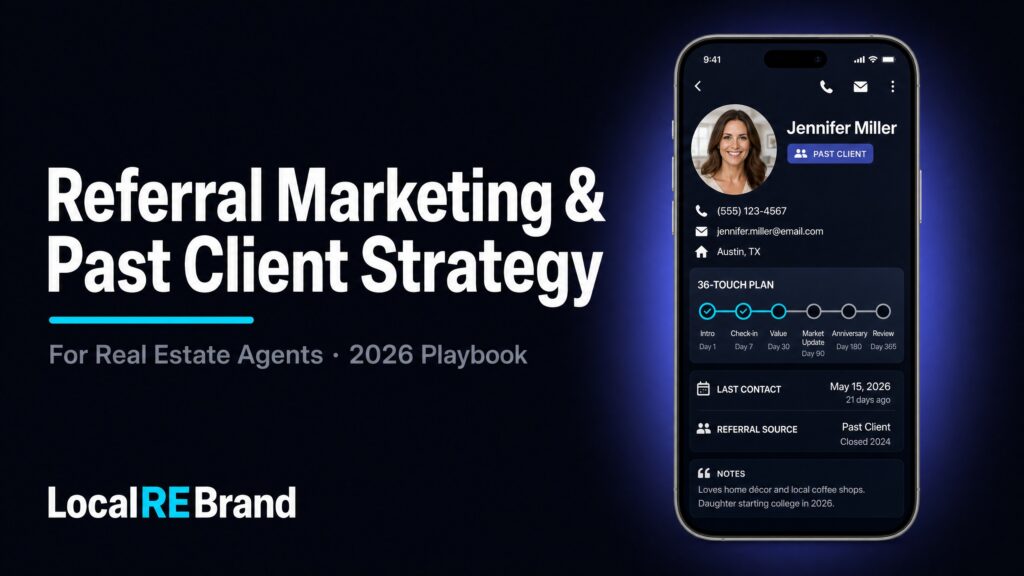
The benchmark for serious past client retention is 36 touches per year — 3 per month — across multiple channels. Industry-standard for the agents producing 40%+ of their business from referrals (Mile High Title Guy, 2026).
A 36-touch year for a single past client looks like:
January: Newsletter, neighborhood market update, phone check-in
February: Pop-by gift (Valentine’s), social media engagement, year-ahead email
March: Newsletter, “neighborhood spring report” email, birthday outreach
April: Pop-by gift (spring), social engagement, market update video
May: Newsletter, anniversary of closing (for clients who closed in May), home maintenance email
June: Pop-by gift (summer), social engagement, mid-year check-in call
July: Newsletter, “summer fun in [neighborhood]” content, anniversary email
August: Pop-by (back-to-school), social, recent sales update
September: Newsletter, fall maintenance email, phone check-in
October: Pop-by (Halloween), social, market update
November: Newsletter, Thanksgiving outreach, holiday season prep
December: Pop-by (holiday gift), social, year-end gratitude note
That’s 36 touches, mixed channels, with no single touch feeling like spam.
For a 200-person past-client list, 36-touch annual = 7,200 individual touch-points per year. Sounds enormous. With automation and batching:
- Newsletter (1/month): 12 touches per client, all done in 12 hours/year
- Social engagement: included in your normal social cadence
- Pop-by gifts (6/year): 6 touches × 200 clients = 1,200 deliveries. Group by neighborhood, batch into 4-hour delivery days quarterly.
- Phone calls (4/year): 800 calls × 5 min = 67 hours/year, or 1.3 hours/week
- Personal emails (anniversaries, birthdays): 4–6 per client × 200 = 1,000 emails, mostly templated
Total time investment for 200 past clients: ~3–4 hours per week. The lowest-effort, highest-ROI marketing in real estate.
Full framework in The Real Estate Agent’s Annual Past Client Touch Calendar.
How to Build the Past Client Database
Most agents have a past client list. Few have a useful past client database.
The minimum useful fields per client:
- Full name(s) (decision-makers + spouse/partner)
- Address of property bought/sold
- Closing date(s)
- Email address (verified, current)
- Phone number (verified, current)
- Anniversary of closing
- Birthday(s)
- Family members (kids’ names, ages — for personalization)
- Source (how they came to you)
- Communication preferences
- Last contact date
- Notes on transaction or relationship
Segmentation tags:
- Active sphere (high-touch)
- Past client (multi-touch)
- Vendor / referral partner
- Cold past client (re-engagement candidate)
Tools:
Any real estate-native CRM does this well. Follow Up Boss, BoomTown, Sierra Interactive, kvCORE, Wise Agent. Outside of RE-specific tools, HubSpot Free or even a well-built Notion database works for small databases.
Full database build-out in SOI Database Setup for Real Estate Agents (in the SOI pillar).
Pop-By Strategy: The Underrated Tactic
A pop-by is a small gift (typically $5–$15) personally delivered to a past client or sphere member. Combined with a brief in-person visit, it’s the most relationship-building marketing tactic in real estate.
Why pop-bys work:
- Personal delivery creates a face-to-face moment that mailed gifts can’t replicate
- Tactile + memorable (people keep the candle, drink the coffee, remember you)
- Low cost relative to ROI
- Triggers reciprocity — people remember and refer
- Bypasses email and social inbox fatigue
The annual pop-by calendar:
- February: Valentine’s (chocolates, “I’d love your referrals” theme)
- April/May: Spring (gardening tools, “I dig your referrals”)
- July: Summer (S’mores kits, ice cream gift cards, summer-themed)
- September: Fall (apple cider, pumpkin spice items)
- November: Thanksgiving (pie, pies-and-thanks themed)
- December: Holiday (cookies, branded ornaments, charitable donation in their name)
Budget: $5–$15 per gift × 200 clients × 6 events = $6,000–$18,000/year for a 200-person sphere. ROI: typically 3–8 closings per year directly attributable to pop-by relationships in active sphere lists.
The execution:
- Batch deliveries by neighborhood (cluster 8–15 stops per route)
- Use a delivery van or rent a vehicle for the day
- 4–6 hours covers 60–100 deliveries
- If client isn’t home, leave gift on doorstep with handwritten note
- Photograph each delivery for social proof (with permission)
Full pop-by playbook including 25+ specific gift ideas in The Real Estate Pop-By Strategy (With 25 Ideas Under $5).
The Referral Ask: How to Actually Get Referrals
Most agents either never ask for referrals, or ask so awkwardly they actively harm the relationship.
The 4 ask patterns that work:
1. The natural close-of-transaction ask.
“It’s been amazing working with you. If anyone else you know is thinking about buying or selling in the next year, I’d be honored if you’d send them my way.”
Delivered at closing. Soft, low-pressure, plants the seed.
2. The post-closing anniversary ask.
“Hard to believe it’s been a year since we closed on the Park Hill house! Hope you’ve made it your own. If you know anyone considering a move this spring, I’d love to help them the way I helped you.”
Sent at the 1-year mark. Reactivates the relationship + asks.
3. The “by-the-way” referral ask.
“By the way, I’m always looking to grow my business through people who already trust me. If anyone in your circle is thinking about real estate, I’d love an introduction.”
Used in regular check-in calls or coffee meetings, after the main conversation.
4. The post-review referral ask.
“Thank you again for the kind review. If you know anyone else considering a move, I’d love the chance to help them the same way.”
Tied to the review request workflow — review first, then referral ask.
Rules:
- Always frame as “help” to the referred party, not “help me”
- Be specific (timeline, market, type of client) when possible
- Never offer a referral incentive to clients (legally risky; some states explicitly prohibit unlicensed parties receiving referral compensation)
- Always acknowledge and thank the referrer immediately
- Follow up with the referrer on outcome (closed or not)
Full script library in How to Ask for a Real Estate Referral (10 Scripts).
Agent-to-Agent Referrals: The Industry-Standard 25%
Agent-to-agent referrals are a separate but powerful channel. The standard fee: 25% of the gross commission, with a typical range of 20–30%.
When to use agent-to-agent referrals:
- Out-of-market lead (buyer relocating to a city you don’t serve)
- Out-of-niche lead (luxury client when you specialize in first-time buyers)
- Timing or capacity constraint (you have a great lead but no bandwidth)
- Retiring (handing off long-term clients)
- Reciprocal relationship (you trade referrals with a specific out-of-area agent)
The legal requirements:
- Both agents must hold active real estate licenses in their respective states
- Referral agreement must be in writing
- Fee is paid through brokerages, not agent-to-agent directly
- Fee is paid only on closed transactions
Building an agent-to-agent referral network:
- Identify 10–20 agents in adjacent markets you’d send leads to (and they’d send leads to you)
- Build relationships through conferences, designations programs (CRS, ABR, GRI), LinkedIn
- Use formal referral platforms (ReferralExchange, Agent Pronto) if you don’t have established relationships
- Track every referral sent and received — close the loop on outcomes
A well-built agent referral network can produce 10–30 referrals per year for active relationship-builders. Most agents have 0–3 because they never built the network.
Vendor Partnerships: The Underrated Referral Source
Beyond agent-to-agent and past-client referrals, the third referral source most agents under-leverage: vendor partnerships.
The vendors in your ecosystem:
- Mortgage lenders
- Title companies
- Home inspectors
- Stagers
- Photographers
- Contractors and tradespeople
- Insurance agents
- Estate planning attorneys
- Financial advisors
- Movers
Each of these vendors interacts with potential buyers and sellers regularly. Mutual referral relationships (you send them business, they send you business) compound over years.
Building vendor partnerships:
- Pick 1–2 top vendors per category
- Refer them consistently — every buyer to your lender, every seller to your stager
- Stay top-of-mind through periodic check-ins
- Provide value beyond referrals (mention them in newsletter, tag in social posts, attend their events)
- Track which vendors actually reciprocate — drop the ones who only take
Best vendor types for inbound referrals to agents (in approximate order):
- Mortgage lenders — see buyers earliest in the funnel
- Estate planning attorneys — handle inherited property transactions
- Financial advisors — clients ready to invest or relocate
- Divorce attorneys — sensitive but recurring referral source
- Insurance agents — life-event-triggered referrals
Full vendor strategy in Vendor Networking: The Underrated Real Estate Growth Channel (in SOI pillar).
Closing Gifts That Generate Referrals
Closing gifts are not just “thanks.” They’re the first impression of your post-closing relationship — which determines whether the client becomes a long-term referral source or not.
The closing gift framework:
- Tied to the property or client (personalized, not generic)
- Memorable (something they’ll display, use, or talk about)
- Photographable (you want them to share on social media)
- Quality (cheap gifts feel like an afterthought)
- $50–$300 budget range for most transactions
Closing gift ideas that consistently generate referrals:
- Custom artwork of their new home (commissioned watercolor or line drawing — $100–$300)
- Cutting board with their address engraved
- Champagne or wine, named with their address/closing date
- Custom doormat with their family name
- Local business gift card paired with a personal note
- Coffee subscription for 6 months
- Professional photo session in their new home
- Home tool kit or “first home” survival kit (for first-time buyers)
What doesn’t work as well:
- Generic flower bouquets (forgotten in a week)
- Cash or gift cards alone (transactional feel)
- Branded swag with your logo (it’s about them, not you)
Full closing gift guide in Real Estate Closing Gifts That Generate Referrals.
Reactivating “Lost” Past Clients
Every agent has past clients who’ve gone cold — no response to emails, no engagement, no contact in years. These are still valuable. Most are simply waiting to be re-engaged.
The re-engagement playbook:
Step 1: Audit. List past clients with no contact in 12+ months. Prioritize by transaction value and original relationship strength.
Step 2: Personal outreach (not email). Phone call or handwritten note, not automated email. Reference something specific from their transaction.
Step 3: Offer value without an ask. First reactivation contact has zero ask. Just “checking in.” Market update for their property, neighborhood news, etc.
Step 4: Re-establish cadence. If they re-engage, add them back to your standard 36-touch system. If they don’t, mark them inactive after 3 attempts and move on.
Step 5: Track. Document re-engagement attempts and outcomes. Some past clients are gone forever (moved, divorced, deceased). Others come roaring back when reminded you exist.
Full reactivation strategy in Reactivating “Lost” Past Real Estate Clients.
Client Appreciation Events: ROI vs. Vibes
Annual client appreciation events are common but variable in ROI. Done well, they’re the single highest-bonding marketing investment per dollar. Done poorly, they’re an expensive way to feed people who weren’t going to refer you anyway.
Event formats that consistently produce ROI:
- Small dinner parties (8–12 people, your home or a private restaurant room). High-trust, deeply personal.
- Annual holiday open house (your home, 30–60 guests). Builds tribe feel.
- Themed seasonal events (pumpkin patch day, spring garden tour, holiday lights tour). Family-friendly, easy invite.
- Wine tasting / cooking class (sponsored by you, executed by vendor). Professional-feeling, memorable.
- Movie nights (rent out a theater for a Saturday matinee with families). High-impact, low-actual-cost.
Event formats with poor ROI:
- Generic “happy hours” (forgettable)
- Holiday party at a hotel ballroom (impersonal at scale)
- Events with no follow-up plan (the event is just the start)
The follow-up matters more than the event.
Within 48 hours of an event:
– Personal thank-you to every attendee
– Photo sharing (with permission)
– Specific recap of memorable moments
– Soft re-engagement (“loved seeing you — let’s connect on [topic]”)
Full event playbook in Real Estate Client Appreciation Events: ROI vs. Vibes.
Tracking Referrals: What to Measure
The metrics that matter for referral marketing:
- Referral source breakdown. Past client / SOI / agent / vendor / other.
- Touchpoints per past client per year. Target: 36 for top tier.
- Time since last contact, per client. Flag anyone over 90 days.
- Closed deals attributed to referrals. Quarterly.
- Referral lifetime value. Original referrer + all subsequent business they triggered.
- Net Promoter Score (NPS). Annual survey to past clients. Predictor of referral velocity.
CRMs handle most of this. The agents who actually track see compounding patterns within 18 months and dominate within 5 years.
The 30/60/90 Past Client Plan
Days 1–30: Database build.
– Audit and clean past client database
– Add segmentation tags
– Set up CRM with anniversary, birthday, last-contact tracking
– Plan the 36-touch annual calendar
Days 31–60: First touches.
– Send first monthly newsletter
– First pop-by round (a small, simple gift for everyone)
– Personal call to 25 top past clients
– Confirm contact info, learn what’s changed
– Identify cold past clients for re-engagement
Days 61–90: Cadence.
– Continue monthly newsletter
– Second pop-by round
– 25 more personal calls (covering the rest of top sphere)
– First quarterly review of touches sent vs. plan
– First referral asks integrated into conversations
After 90 days, you’ve executed the foundation of a referral-driven business. Year 2 is where the compounding shows up in your deal count.
Frequently Asked Questions
Q: How long until referral marketing produces business?
Referrals from existing past clients can come immediately if your past clients are recent and warm. From a cold or rebuilt sphere, expect first referrals in months 3–6 and compounding by year 2.
Q: How much should I spend on past client retention annually?
$50–$200 per past client per year is the typical range. For a 200-person sphere, $10K–$40K annually. The ROI math: even at the high end, you only need 2–3 closed referrals to break even — and the math says you’ll get 6–15.
Q: Should I send a closing anniversary gift every year?
Yes for top-tier past clients (the ones who consistently refer or have repeat potential). For broader past clients, the first-year anniversary and milestone years (5, 10) are sufficient.
Q: Can I offer my past clients money for referrals?
In most states, no. Real estate referral fees can only be paid to other licensed real estate agents in licensed-to-licensed transactions. Offering clients money or gifts contingent on referrals can violate state real estate law and FTC consumer protection rules.
Q: What’s a “good” referral rate?
For experienced agents, 40%+ of annual business from past clients + referrals is the target. NAR data shows 41% as the average for experienced agents — so 50%+ is genuinely strong, 60%+ is dominant.
Q: Should I refer leads to other agents when I’m too busy?
Yes. A referred lead at 25% of the commission is better than a lost lead at 0%. Agents who refer out when overwhelmed earn passive income, maintain client trust, and build reciprocal networks. The mistake is hoarding leads you can’t serve well.
Q: How do I handle past clients who never respond?
Re-engagement sequence (covered above), then suppression. Don’t keep emailing people who haven’t engaged in 18+ months — it hurts your deliverability and your time. Mark them inactive, keep in database, revisit annually.
What to Do This Week
If you only do five things this week:
- Pull your past client list into your CRM. Clean, deduplicate, verify.
- Pick 25 top past clients. Personal phone call to each one this week. No agenda — just check in.
- Plan this year’s pop-by calendar. 6 events, 6 gift ideas, 6 delivery dates.
- Set up your monthly newsletter cadence. Pick the day, pick the format, write the first one.
- Add the 36-touch system to your CRM as an automated annual plan.
For a free 30-minute referral strategy session, book here.
Jon Smith is a 20+ year SEO veteran specializing in real estate agent client retention and referral systems. He has built past-client engines for hundreds of agents and teams across North America. Connect on LinkedIn or read more on LocalReBrand.com.
Sources & further reading:
- How to Turn Real Estate Clients Into Lifetime Referral Machines — The Perna Team
- 36-Touch Past-Client Plan for Denver Agents 2026 — Mile High Title Guy
- Real Estate Referral Fees Guide 2026 — Luxury Presence
- The Complete Guide to Real Estate Referral Fees 2026 — The Close
- 25 Real Estate Pop-by Ideas — The Close
- Build a Real Estate Referral Network 2026 — Jamil Academy
- Ultimate Guide to Real Estate Client Retention — Contempo Themes