Answer Summary
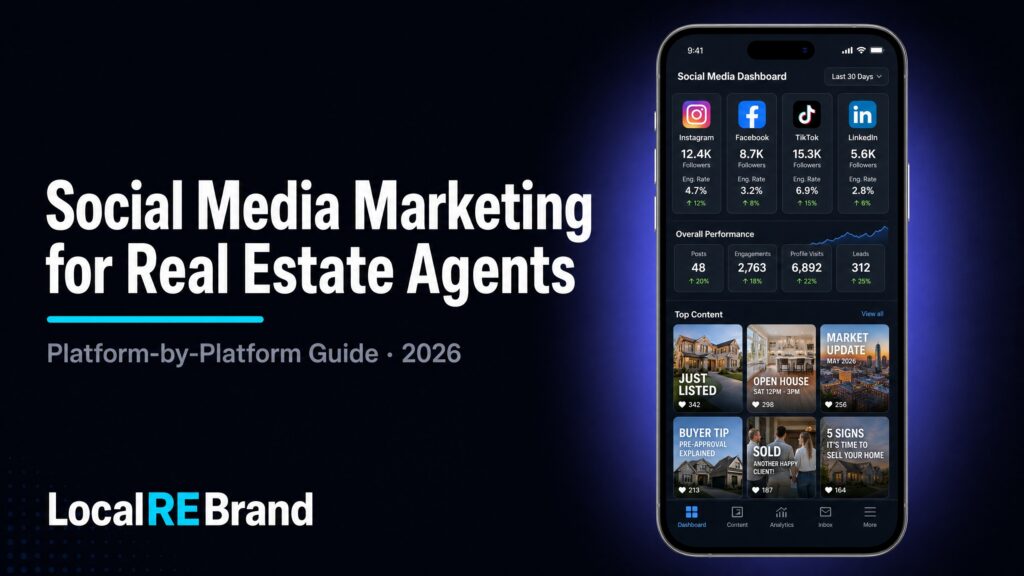
Social media for real estate agents in 2026 is not about being everywhere — it’s about being deliberately present on the two or three platforms where your specific buyers and sellers actually spend time. The math: Instagram for blended local audience and Reels reach, Facebook for community groups and your existing sphere, LinkedIn for high-net-worth professional buyers, TikTok for the discovery arbitrage (only 13% of agents are on it vs 37% of consumers), YouTube as the long-form authority engine. Two platforms, posted consistently, with a clear content mix, will outperform six platforms posted sporadically.
Key Takeaways
- 87% of real estate agents use Facebook, 62% Instagram, 48% LinkedIn, 25% YouTube, and only 13% TikTok (Apaya, 2026). The TikTok gap (37% of consumers vs 13% of agents) is the biggest visibility arbitrage in 2026.
- Highest engagement rates by platform: Instagram 4.23%, LinkedIn 3.36%, Facebook 2.09% — all peaking at 2 posts per week per platform.
- Real estate listings shared with video receive 403% more inquiries than photo-only listings.
- 80% of all B2B social media leads come through LinkedIn. The platform converts high-net-worth prospects at higher rates than all other social channels combined for real estate (Jamil Academy, 2026).
- Instagram 2026 content mix that works: 60–70% Reels, 20–30% carousels, 10% single images. Carousels are getting a major algorithm boost in 2026.
- Captioned Reels get up to 40% more engagement. Captions are mandatory in 2026.
Why Most Agents Lose on Social Media (and How Not To)
Twenty years in this game and I’ve seen the same agent social media failure pattern hundreds of times:
- Open accounts on 5 platforms in the same week
- Post inconsistently for 30 days
- Burn out
- Conclude “social media doesn’t work for real estate”
- Go back to paying for Zillow leads at $60 each
The agents who actually generate leads from social do the exact opposite. They pick two platforms based on their market and their target client. They commit to a 12-month cadence. They mix content types intentionally. They treat the platforms as distribution layers for the same core content, not separate channels.
This pillar is the platform-by-platform breakdown plus the cross-platform workflow that makes it sustainable.
How to Choose Your Two Platforms
The mistake: picking platforms by personal preference. The right way: by where your specific clients are.
Pick Instagram if:
– Your market is primarily 28–55-year-old buyers and sellers
– You can post visually — listings, neighborhoods, behind-the-scenes
– You have access to short-form video content
– Your client base skews lifestyle/aesthetic
Pick Facebook if:
– Your sphere is large and lives on Facebook
– Local community groups are strong in your market
– Your target client is 35–65 (slightly older demo than IG)
– You’re running paid ads (Facebook still has best targeting tools)
Pick LinkedIn if:
– Your target is executives, professionals, or business owners
– You sell luxury or higher price points
– Relocation/corporate transferee buyers are part of your business
– You want B2B referral relationships with mortgage, title, etc.
Pick TikTok if:
– You’re under 40 and comfortable on camera
– Your market has buyers/sellers 22–40
– You can commit to daily short-form video
– You want the discovery-channel arbitrage (only 13% of agents are there)
Pick YouTube as a third platform (already covered in Real Estate Video Marketing) — it’s a search engine, not social media, but it operates alongside your social stack.
Default recommendation for most agents in 2026: Instagram + Facebook + YouTube + LinkedIn if you have referral/business audiences, or Instagram + YouTube + TikTok if you’re under 45 and your market skews younger.
Instagram for Real Estate Agents
Instagram is the highest-engagement platform for real estate in 2026 with a 4.23% engagement rate at optimal cadence.
Profile setup:
– Username: your name + market (e.g., @jonsmith.denver, @jonsmithrealtor)
– Bio: clear positioning (“Denver real estate agent | East side specialist | Free home valuation ↓”)
– Link in bio: Linktree, Beacons, or a dedicated landing page with multiple offers
– Profile photo: professional headshot, branded color background
– Highlights: pinned categories — Listings, Sold, Reviews, Neighborhoods, About
The 2026 content mix:
– 60–70% Reels (reach + new followers)
– 20–30% carousels (saves + shares — heavily boosted in 2026)
– 10% single images (filler, low priority)
– Stories daily (DM conversations + lead activation)
Content categories to rotate through:
– Listings (your active + just-sold)
– Local lifestyle (neighborhood spots, events, things to do)
– Education (buyer/seller tips, market explainers)
– Market commentary (data + interpretation)
– Personality (you as a person, not just an agent)
– Social proof (testimonials, closings, before/after)
Cadence: 4–5 posts per week, mixing formats. Stories daily.
Critical 2026 wins:
– Captions on every Reel (40% engagement lift)
– Location tags on every post
– Collaborator posts when partnering with vendors (lender, stager, photographer)
– Reply to every DM within 1 hour
– Use Instagram’s “Highlight” feature aggressively — pin your best content
Full Instagram playbook in Instagram for Real Estate Agents: A Complete Profile Optimization Guide.
Facebook for Real Estate Agents
Facebook still has the largest agent adoption (87%) and the largest active sphere audience for most agents. Engagement is lower than IG (2.09% at optimal cadence) but the platform serves a different purpose: relationship maintenance and community presence.
Profile setup:
– Personal profile: your professional identity, public-facing
– Business Page: separate from personal, for ads and analytics
– Page name: your full name or DBA + Realtor designation
– Cover image: branded, with clear positioning and CTA
What actually works on Facebook in 2026:
-
Local community groups. Most markets have 5–20 active local Facebook groups (neighborhoods, parents, lifestyle, civic). Join, contribute value, become known. Do not spam listings.
-
Posts that drive saves and shares. Albums of properties (highest-engaging format at 2.9%). Hyperlocal posts about restaurants, events, school news. Market updates.
-
Live videos. Underused but Facebook still pushes Live content. Live Q&A monthly, virtual open houses, market updates.
-
Facebook Marketplace listings. Free secondary distribution for your listings.
-
Targeted ads. If you run paid social, Facebook still has best targeting for real estate (homeowners, life events, income ranges, neighborhoods). Budget $300–$1,500/month for sustained pipeline.
Cadence: 2 posts per week on your business page. Active engagement in groups daily.
Don’t waste time on: Boosting every post randomly. Posting only listings. Auto-syndicating IG content (Facebook algorithm penalizes cross-platform reposts visibly).
Full Facebook strategy in Facebook for Real Estate Agents: Groups, Pages, and Local Reach.
LinkedIn for Real Estate Agents
LinkedIn is the most underused high-leverage platform for real estate agents in 2026. The math is clear:
- 50%+ of LinkedIn users earn more than $75,000 (highest-income audience of any major social platform)
- 80% of all B2B social leads come through LinkedIn
- LinkedIn is 277% more effective for B2B lead gen than Facebook and Twitter combined
- LinkedIn engagement rate for real estate: 3.36% at 2 posts/week
If your target client is a professional, executive, business owner, or high-net-worth buyer, LinkedIn is mandatory.
Profile setup:
– Headline: not “Realtor at XYZ Brokerage” — “Helping Denver professionals buy and sell luxury real estate” or similar specific positioning
– About: 1,500–2,000 character story-driven bio with credentials, niche, contact CTA
– Featured: pin your best content (article, video, case study)
– Banner: branded, with positioning statement
– Activity: post 3–5 times per week, engage on 10–15 other people’s posts daily
Content categories that work on LinkedIn:
– Market commentary with data
– Long-form articles on relocation, investment, luxury
– Behind-the-scenes professional (“I just closed on a [neighborhood] luxury sale — here’s what made it different”)
– Industry commentary (NAR settlement implications, market shifts)
– Local economic / development news with your interpretation
Don’t post on LinkedIn:
– Listings without context
– Generic Instagram content
– Personal/lifestyle content that belongs on IG
Outreach (the real LinkedIn play):
– Connect with local executives, business owners, professionals
– Engage authentically on their posts before pitching anything
– Send personalized, value-first messages (never sales-first)
– Build a list of 100 high-value referral sources and stay in touch quarterly
The agents who win on LinkedIn aren’t viral creators — they’re systematic networkers. Full strategy in LinkedIn for Real Estate Agents: How to Win High-Net-Worth Leads.
TikTok for Real Estate Agents
The biggest opportunity in 2026: only 13% of real estate agents are on TikTok, while 37% of US consumers actively use it. The gap is the largest of any major platform.
If you can commit to daily short-form video, TikTok is the highest-leverage discovery channel available to real estate agents right now.
What works on TikTok in 2026:
- 20–45 second videos. Sweet spot for retention and algorithmic push.
- Vertical (9:16), native style. No corporate ads, no logos in corners, no overproduction.
- Hook in first 1–3 seconds. “If you’re buying in Denver in 2026, watch this before you sign…”
- Hyperlocal + specific. “What $700K buys you in Stapleton vs Park Hill” outperforms “Denver real estate trends.”
- Trending sounds (sometimes). Hijack trending audio when relevant. Don’t force it.
- Authentic, not polished. TikTok rewards realness over production.
Content categories:
– Property tours (60-second highlights of listings)
– Neighborhood walks (“walking through Cherry Creek with you”)
– Market commentary (“3 things changed in Denver real estate this week”)
– Buyer/seller tips (single-tip format, one idea per video)
– Day-in-the-life
– Q&A response videos (respond to comments with a new video)
Cadence: Daily is the floor for meaningful algorithmic traction. 5/week is the minimum sustainable cadence. Less than that and TikTok deprioritizes your account.
Cross-post to: Instagram Reels, YouTube Shorts, Facebook Reels. Same vertical video, four placements, four times the reach.
Full TikTok strategy in TikTok for Real Estate Agents: What Works in 2026.
Posting Frequency and Engagement Math
Counter to most “post more!” advice, the 2026 data shows engagement peaks at moderate frequency on most platforms:
| Platform | Optimal posts/week | Peak engagement rate |
|---|---|---|
| 2 (feed) + daily Stories | 4.23% | |
| 2 | 2.09% | |
| 2 | 3.36% | |
| TikTok | Daily | Variable, reach-driven |
| YouTube | Weekly long-form + 3–5 Shorts | Search-driven |
What this means in practice:
- More isn’t better past a threshold. 4 great Instagram posts per week beats 14 mediocre ones.
- Stories don’t count against your feed frequency — post Stories daily without worrying about cannibalization.
- Cross-posting drops engagement. Same video on IG and TikTok gets ~30% less engagement on each than a native-edited version.
- Consistency beats bursts. 2 posts/week every week for a year outperforms 10 posts/week for a month then nothing.
Content Mix and Lane Strategy
The 6-lane content mix that works for real estate agents on social media in 2026:
| Lane | % of posts | Purpose |
|---|---|---|
| Listings | 20% | Active and just-sold inventory |
| Local lifestyle | 25% | Neighborhoods, restaurants, events |
| Education | 20% | Buyer/seller tips, market explainers |
| Market | 15% | Data + interpretation, monthly updates |
| Personality | 10% | You as a human, behind-the-scenes |
| Social proof | 10% | Testimonials, closings, before/after |
Rotate through the lanes weekly. Don’t dump 5 listings in a row — the algorithm reads it as commodity content and depresses reach.
Full content category playbook in How Often Should Real Estate Agents Post on Each Platform? and the post-idea library in 20 Must-Try Real Estate Social Media Post Ideas.
Hashtag Strategy (Local, Not Generic)
Hashtag math changed in 2026. Generic hashtags (#realestate #realtor) are too saturated to drive discovery. Hyperlocal and niche hashtags are the move.
The hashtag formula for each post:
– 3–5 hyperlocal hashtags (#StapletonDenver #ParkHillRealEstate #DenverEastSide)
– 2–3 niche hashtags (#FirstTimeHomebuyer #DenverLuxury #RelocatingToDenver)
– 1–2 branded hashtags (your own + your team’s)
– 2–3 broader-but-relevant (#DenverRealEstate #DenverHomes)
Avoid: #realestate, #realtor (too saturated). 30-hashtag spam posts (algorithm reads as spam). Banned hashtags (check periodically, some get flagged).
Full hashtag strategy in Real Estate Hashtag Strategy: Local Hashtags That Drive Real Leads.
Stories, DMs, and the Conversation Layer
Public posts build awareness. Stories and DMs convert awareness to leads.
Stories playbook:
– Daily, 3–5 stories per day
– Behind-the-scenes, polls, questions, “what’s new”
– Use interactive stickers (polls, questions, sliders) — they boost story reach
– Pin to Highlights monthly
– Add link stickers to listings, blog posts, lead magnets
DM playbook:
– Reply to every DM within 1 hour during business hours
– Treat DMs as warm leads — they’re already engaging
– Don’t pitch immediately. Acknowledge → ask a question → invite to a real conversation (phone or in-person)
– Save common responses as quick replies for efficiency, but personalize the opener
Conversion through engagement:
The agents who close the most from social aren’t the ones with the most followers — they’re the ones with the most active DM conversations. Building 5 real DM conversations per week beats 5,000 followers who never message you.
Cross-Platform Workflow
Here’s the workflow that makes 4 platforms sustainable for one agent:
Monday: Plan + Batch.
– Review the week’s content calendar
– Pull stock visuals, listing photos, neighborhood photos
– Write captions for all the week’s planned posts
Tuesday: Film + Photograph.
– Batch-record any video content (4–8 short-form videos)
– Photograph any new listings, neighborhoods, behind-the-scenes
– Take a half-day; produce a week’s worth of raw content
Wednesday: Edit.
– Edit short-form videos (CapCut, InShot — 15–30 min per video)
– Edit photos (Lightroom mobile or similar)
Thursday–Sunday: Publish + Engage.
– Auto-schedule via Later, Buffer, or Metricool — but engage in real time
– Reply to comments and DMs within an hour during business hours
– Engage on other people’s content daily (10–15 meaningful comments)
Total time per week: 4–6 hours after the system is set up.
Measurement and ROI
What to track:
Vanity (track but don’t overweight):
– Followers
– Likes
– Impressions
Engagement (real signal):
– Saves and shares (highest-quality signal)
– Comments (real conversations)
– DM volume
– Profile clicks
– Story replies
Conversion (what matters):
– Link clicks to your website
– Lead magnet downloads
– DM-initiated conversations
– Booked consultations
– Closed deals attributed to social
UTM your links so you can attribute leads back to specific platforms and posts. The agents I work with who track this seriously discover within 6 months which 2 platforms are actually driving their business — then they double down there and drop the rest.
Common Real Estate Social Media Mistakes
In 200+ agent audits, the same mistakes show up:
1. Listings-only feed. Looks like an MLS dump. Algorithms downrank it; humans scroll past.
2. Cross-posted Instagram → everywhere. Same caption, same image, same hashtags on 5 platforms. Engagement drops on every platform.
3. Inconsistent posting. 12 posts in March, none in April. Algorithm forgets you.
4. No engagement. Posting but never commenting on others’ posts. Social media is social — you can’t be one-way.
5. Ignoring DMs. Top performers on social have inbox-zero discipline. Slow responses kill conversions.
6. Wasting time on the wrong platform. A 60-year-old luxury agent posting daily TikToks. A 30-year-old urban agent ignoring TikTok. Choose your platforms based on your market, not your comfort zone.
7. No clear positioning. “Just a Denver real estate agent” — same as every other one. Pick a niche, a market, a specialty. Be specific.
8. Buying followers. Detectable, useless for conversions, often gets accounts flagged.
The 30/60/90 Plan for New Social Media
Days 1–30: Setup.
– Audit existing profiles, archive what’s stale
– Pick your 2–3 platforms based on this guide
– Rebuild profile/bio/links on each
– Plan first 30 posts using the lane mix
– Post first 12 pieces of content (2/week × 4 weeks per platform)
Days 31–60: Cadence.
– Continue 2x/week feed posts + daily Stories
– Engage 10–15 minutes/day on others’ content
– First analytics review — what content lanes are converting?
– Build first 5 DM conversations into real leads
Days 61–90: Optimization.
– Adjust content mix based on what’s working
– Test new content formats (carousels, Reels, Lives)
– Run first small ad budget (if Facebook is in your stack)
– Establish weekly recurring time blocks for content production
After 90 days you’ll have a clear signal on which platforms are converting and which aren’t. Cut the underperformers, double down on what’s working.
Frequently Asked Questions
Q: How many social media platforms should a real estate agent be on?
Two to three for most agents. Five+ is unsustainable for one person and produces inconsistent posting everywhere. Pick based on your market and your target client.
Q: Should I run Facebook or Instagram ads?
Once you have organic momentum and a clear lead funnel, yes. $300–$1,500/month is the right starting range. Don’t run ads to a profile that has zero recent activity — the click-through doesn’t convert.
Q: How often should I post listings vs. other content?
20% listings, 80% other. Listings-only feeds get algorithmically suppressed.
Q: What’s the best time to post for real estate?
Depends on your platform and audience. General benchmarks: Instagram 11am–1pm and 7–9pm local. Facebook 9–11am. LinkedIn 7–9am and 4–6pm weekdays. TikTok 6–10pm. Test for your specific audience.
Q: Should I use AI tools to generate captions?
You can use AI to help draft and refine — never to generate captions you post unedited. FTC Consumer Review Rule applies if you’re using AI to fake testimonials. Apply the same EEAT logic from the content marketing pillar.
Q: How do I measure social media ROI?
Track UTM-tagged links, DM-attributed leads, and closed deals. The math: total hours spent ÷ closed deals attributed = effective cost per deal from social. Compare to your other channels.
Q: Do followers matter?
Less than engagement. 1,000 highly-engaged local followers will outperform 50,000 random followers every time. Build the right audience, not the biggest one.
Q: Should I cross-post the same content everywhere?
Cross-post strategically — don’t auto-post. Adapt captions for each platform’s tone and audience. Keep the core idea consistent.
What to Do This Week
If you only do five things this week:
- Audit your existing profiles on every platform. Archive what’s stale. Update bios.
- Pick your 2–3 platforms based on this guide. Drop the others.
- Plan your first 12 posts using the lane mix (listings, lifestyle, education, market, personality, social proof).
- Schedule a recurring 4-hour batch day every week or every other week for content production.
- Start engaging on 10 other people’s posts per day in your market. Build presence before you push content.
For a free 30-minute social media strategy session, book here.
Jon Smith is a 20+ year SEO veteran specializing in real estate agent local search and social presence. He has built social strategies for hundreds of solo agents and teams across North America. Connect on LinkedIn or read more on LocalReBrand.com.
Sources & further reading:
- Real Estate Social Media Benchmarks 2026 — Apaya
- Best Social Media Platforms for Real Estate Agents — Apaya
- Real Estate Leads from LinkedIn 2026 — Jamil Academy
- LinkedIn for Realtors 2026 — Jamil Academy
- Instagram for Real Estate Marketing — Inman
- TikTok Real Estate Leads 2026 — Jamil Academy
- How Real Estate Agents Win on Social Media 2026 — South Florida Agent Magazine
- Social Media Benchmarks 2026 — Hootsuite