Answer Summary
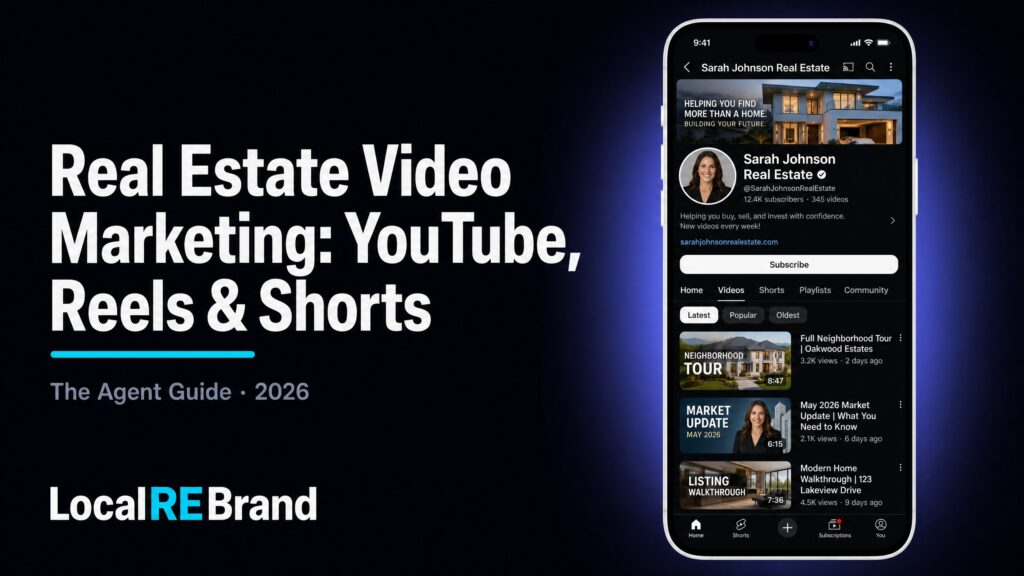
Video is the single highest-trust media format in real estate marketing. A buyer who watches three of your YouTube videos arrives at the first call having already decided to work with you. In 2026, the winning agent video strategy is dual-stack: YouTube as the long-form search engine (drives inbound, high-intent leads in months 6–12, then compounds), plus short-form (Reels/TikTok/Shorts) as the discovery layer (builds reach and feeds the YouTube subscriber funnel). Film once, distribute everywhere, treat YouTube as SEO not social, and focus on hyperlocal, market, and education content over viral attempts.
Key Takeaways
- Only 12% of real estate agents are active on TikTok while 92% are on Facebook — the discovery channel arbitrage favors the agents who show up early on short-form (Jamil Academy, 2026).
- Most agents following a consistent YouTube SEO strategy convert their first YouTube buyer in months 6–12, then 3–8 closings per year by year two, with ROI in the 15–50x range once the back catalog compounds (LabCoat Agents, 2026).
- Short-form sweet spot: 20–45 seconds per video. Vertical format. Native style. Film once, distribute to TikTok + Reels + Shorts.
- YouTube video titles are the #1 ranking factor on the platform. Description primary keyword in first 125 characters. Transcripts are mandatory in 2026.
- AI search engines now actively cite YouTube videos. Videos with structured answers in the first 60 seconds get cited by ChatGPT, Perplexity, and Google AI Overviews (JCT Growth, 2026).
- Equipment doesn’t matter. iPhone on a tripod + $20 lapel mic outperforms expensive gear with inconsistent posting.
Why Video Is the Highest-Leverage Marketing Channel in Real Estate
Two years ago I sat with a Denver agent who had been on YouTube for 18 months. 47 videos. 1,200 subscribers. Nothing impressive on the surface. Then she walked me through her closings.
Of her 14 transactions in the previous 12 months, nine originated from her YouTube channel. Buyers and sellers who’d watched five, ten, sometimes twenty of her videos before ever reaching out. Almost zero objection-handling on first calls. Higher commission negotiation power because they’d self-selected to work with her specifically. Effective cost-per-lead from organic video: zero.
Video produces a kind of trust no other format can match. A buyer who watches you walk through Stapleton on a Saturday morning, talking about which streets get the best afternoon light, sees you as a person — not a brand, not a logo, not a smiling headshot on a bus bench. By the time they call, the decision is already made.
This pillar is the full system: long-form YouTube as the inbound engine, short-form as the discovery layer, and the workflow that makes it sustainable.
The 2026 Video Stack: YouTube + Short-Form, Not Either/Or
Most agents pick one and burn out. The agents who win pick both, and design the workflow so one feeds the other.
YouTube (long-form, 5–15 minutes).
– Functions as a search engine, not social media. Videos rank in YouTube search and Google search.
– Builds inbound demand from high-intent buyers and sellers who are already researching.
– Compounds. A video filmed today still drives leads in 2030.
– Slower payoff (months 6–12 before first lead) but exponential thereafter.
Short-form (Reels / TikTok / Shorts, 20–45 seconds).
– Discovery channel. Pushes content into people’s feeds without them searching.
– Builds reach, awareness, and feeds your YouTube subscriber funnel.
– Faster engagement, higher posting cadence, less compounding equity per video.
– Best for hyperlocal market commentary, day-in-the-life, quick property highlights.
The workflow: Film a 10-minute YouTube video. Pull 3–5 short clips from it. Vertical-format the clips, add captions, post to Reels, TikTok, Shorts. One filming session → six pieces of content across two formats.
What to Post: The 5 Video Categories That Convert
Through hundreds of agent channel audits, the categories that consistently produce leads:
1. Neighborhood guides. “Living in Stapleton, Denver: 2026 Edition.” “What’s it like to live in Park Hill?” “5 Best Streets in Cherry Creek.” Highest commercial intent, highest conversion rate, lowest competition. Your moat.
2. Market updates. “Denver Real Estate Market — May 2026.” “Is now a good time to buy in Aurora?” “What rising rates mean for Denver sellers.” Refresh monthly. Builds you as the local market authority.
3. Buyer education. “Mortgage pre-approval explained for Denver buyers.” “What to expect at your first showing.” “The Denver buyer agreement after the NAR settlement.” Long-tail search, high commercial intent.
4. Seller education. “Should I stage my home in 2026?” “What to fix before listing in Denver.” “Pricing strategy in a balanced market.” Higher-ticket commercial intent.
5. Personal / behind-the-scenes. “A day in the life of a Denver real estate agent.” “Why I switched brokerages.” Builds trust and brand affinity but doesn’t drive direct leads on its own — supports the rest.
Avoid: pure “tips” listicles (“10 tips for first-time buyers”). They’re commodity content and they don’t rank.
YouTube SEO for Real Estate Agents (How to Actually Rank)
YouTube is a search engine. Treat it like one.
Title (the #1 ranking factor):
– Primary keyword in first half
– Locale specificity
– Curiosity hook
– 60 characters or less for full visibility
Good titles:
– “Living in Stapleton Denver: Honest Pros and Cons (2026)”
– “Is It a Good Time to Buy in Denver? May 2026 Market Update”
– “First-Time Homebuyer Mistakes in Denver: 7 to Avoid”
Bad titles:
– “Stapleton homes for sale”
– “Denver real estate”
– “Real estate tips”
Description:
– Primary keyword in first 125 characters (the visible-without-clicking portion)
– 2–3 paragraph summary
– Timestamps with keyword variations
– Links: your website, contact, free guide
– Hashtags (3–5 relevant ones at the end)
Tags: Less weight than they used to carry, but still helpful. 8–15 specific tags. Avoid generic single-word tags.
Thumbnail: Custom, high-contrast, clear face if it’s a face-of-camera video, large bold text overlay (3–5 words max). Test in mobile preview. The thumbnail does 80% of the click-through work.
Transcript: Mandatory in 2026. YouTube auto-generates one; edit it for accuracy. AI search engines (ChatGPT, Perplexity, Google AI Overviews) pull from transcripts when citing video sources.
Chapter markers: Add chapters every 60–90 seconds. Each chapter title should include a keyword variation. Chapters help YouTube understand structure and surface specific moments in search.
Retention is everything. YouTube’s algorithm ranks by watch time and retention curve. Strong hook in the first 5–10 seconds. Answer the primary question early. Cut filler.
Full implementation in Real Estate Video SEO: Titles, Tags, and Descriptions That Rank and How to Rank Real Estate Videos in Local YouTube Search.
Short-Form Video for Real Estate (Reels, TikTok, Shorts)
Short-form is fundamentally different from YouTube. The algorithm is discovery-driven, not search-driven. The viewer arrives in their feed with zero intent.
What works in short-form for real estate:
- Hook in 1–3 seconds. “If you’re buying in Denver, watch this before you sign anything…” Pattern-break or surprising statement.
- Vertical (9:16), native, captioned. 80%+ of viewers watch with sound off. Captions are non-negotiable.
- 20–45 seconds. Long enough to inform, short enough to retain.
- One idea per video. Don’t try to teach a course in 30 seconds.
- Local / specific. “Park Hill prices vs. Stapleton” outperforms “Denver real estate trends.”
- Face on camera or property B-roll with voiceover. Static text-only rarely performs.
What doesn’t work:
- Reposting your YouTube intro as a Reel
- Generic motivational content
- Listing-only feeds with no personality
- Heavy editing that takes you 2 hours per video — sustainability dies and posting cadence dies with it
Posting cadence: 3–5 short-form videos per week is the floor for meaningful algorithmic momentum. Daily is ideal.
Platform priority for agents in 2026:
1. Instagram Reels — best blended audience (buyers, sellers, sphere)
2. YouTube Shorts — feeds your YouTube subscriber funnel
3. TikTok — biggest opportunity (only 12% of agents are on it) but highest content-style learning curve
4. Facebook Reels — distribution to your older sphere audience, lower discovery
Cross-post the same vertical video to all four. Don’t optimize per-platform unless you have dedicated time.
How to Film a Property Listing Video (Without Hiring Anyone)
The myth: you need a $5,000 camera and a videographer.
The reality: an iPhone, a gimbal, a $20 lapel mic, and good light.
The 10-minute listing video formula:
Opening (0:00–0:15). You on camera in front of the property. State the address, neighborhood, key stats (bedrooms, square footage, price). Reason someone should watch the next 5 minutes.
Exterior walk (0:15–1:30). Walk the front yard, point out curb appeal details, mention the neighborhood. Show street context.
Interior walkthrough (1:30–6:00). Room-by-room. Talk while walking. Point out unique features. Open closets, open the fridge if it’s the kitchen — humanize it.
Outdoor / backyard (6:00–7:30). Cover backyard, garage, garden if relevant. The “lifestyle” beat.
Neighborhood context (7:30–8:30). Step outside. Talk about what’s within walking distance — schools, parks, restaurants. Hyperlocal value the MLS photos can’t deliver.
Close (8:30–10:00). You on camera again. Recap. Pricing context. Clear CTA — schedule a showing, contact you, etc.
Phone on a $40 gimbal. Lapel mic plugged in. Natural light through windows. Film during the best-light hour for the property (typically mid-morning or late afternoon).
Edit in iMovie, CapCut, or DaVinci Resolve. Don’t over-edit — natural pacing wins over flashy cuts.
Full filming guide in How to Film a Real Estate Listing Video (Without Hiring Anyone).
Equipment Reality Check (What You Actually Need)
I’ve watched agents spend $3,000 on gear and never publish. I’ve watched agents film 200 videos on an iPhone 12 and close six figures of business.
Starter kit (under $200):
– Your phone (iPhone 11+ or Android equivalent)
– Lapel mic ($20 — Boya BY-M1 or similar)
– Phone tripod ($25)
– Ring light or window light (free)
Mid kit (under $800):
– DJI Pocket 3 or Osmo 6 ($400) — handheld stabilized 4K, killer for property tours
– Rode Wireless ME mic ($150)
– Tripod ($50)
– Soft box light kit ($100)
Pro kit (under $3,000):
– Sony ZV-1 II or Canon R50 ($800–$1,200)
– Rode Wireless Pro ($400)
– DJI RS3 gimbal ($400)
– Mic, lights, tripods, SD cards ($500+)
Most agents should not buy the pro kit until they’ve published 50+ videos. The bottleneck is consistency, not gear.
Recommendations refresh annually in The Best Cameras and Gear for Real Estate Agents in 2026.
The Video Workflow That’s Actually Sustainable
Most agents film once, edit for six hours, never film again. The workflow that works:
Batch filming. One Saturday per month. Film 4–6 long-form videos. Use the same outfit (or 2–3) so you can intercut without continuity issues.
Outsource editing. Find an editor on Upwork or Fiverr for $30–$100 per video. Send raw footage, get edited video back within 5 days. Your time is worth more than $30/video.
Repurpose every long video. Pull 3–5 short clips. Vertical-crop. Add captions. Post to Reels/TikTok/Shorts within the week the long video drops.
Publishing cadence:
– 1 YouTube video per week (4 per month from one batch day)
– 3–5 short-form videos per week (12–20 per month from the same batch)
– Total time investment: ~6 hours per month after the workflow is set up
That’s it. Consistency beats every other variable.
Distribution and Cross-Promotion
A new video shouldn’t just sit on YouTube hoping to be discovered. Distribute it:
Immediate (publish day):
– Email your sphere with a 1-paragraph teaser + link
– Share to LinkedIn, Facebook (page + groups), Instagram (link in bio + Story)
– Embed in the related blog post on your website
– Send to active clients/prospects if topically relevant
Week 1:
– 3–5 short-form clips posted from the long video
– Reply to every comment on the YouTube video (algorithm rewards engagement)
– Pin the comment with the best timestamp or follow-up question
Month 1:
– Embed in your weekly newsletter
– Update related blog posts with the embedded video
– If the video performs well, run a small targeted ad to extend reach
Ongoing:
– Refresh thumbnails every 6 months on top-performing videos (can re-trigger algorithmic surface)
– Re-promote during seasonal moments
– Use as evergreen content in buyer/seller consultations
Tracking and Measurement
YouTube and short-form have different KPIs. Track both.
YouTube:
– Views (volume)
– Watch time / average view duration (retention quality)
– Click-through rate on thumbnails (CTR — target 5–8%+)
– Subscribers added per video
– Comments and engagement rate
– Direct traffic to your website from YouTube
– Leads attributed to YouTube (with UTM parameters)
– Conversions to client engagements
Short-form:
– Reach / impressions
– Plays / video views
– Average watch time (target 50%+ completion)
– Saves and shares (the highest-quality engagement signals)
– Profile clicks
– DMs initiated
– Follower growth
Set a monthly review block. The agents who actually look at their numbers improve them.
The 30/60/90 Plan for a New Video Agent
Days 1–30: Setup and first batch.
– Pick channel name (your name, ideally)
– Create branded thumbnail template
– Write channel “about” with EEAT signals
– Film and publish first 4 long-form videos (1 per week pace)
– Publish 12 short-form videos (3/week)
Days 31–60: Optimization.
– 4 more long-form videos
– 12 more short-form
– First analytics review
– Adjust topics based on what’s resonating
– Set up YouTube end screens, cards, channel art
Days 61–90: Momentum.
– Continue cadence
– First playlist organization (group videos by theme)
– Engage with comments daily
– Start reaching out to local creators for collabs
– Repurpose top-performing video into blog post + LinkedIn article
After 90 days you have 12 long-form videos + 36 short-form. Enough mass for the YouTube algorithm to start surfacing you in search and for the short-form algorithms to know what to do with your account.
Frequently Asked Questions
Q: Do I have to be on camera?
For long-form, yes — face-on-camera videos build trust 10x faster than voiceover-only. For short-form, you can mix face-on-camera with property B-roll + voiceover. Cover both styles.
Q: I hate my voice / I’m not photogenic.
Everyone says this. The viewers who become your clients aren’t looking for a TV anchor — they’re looking for someone they can trust with the biggest financial decision of their life. Authentic > polished.
Q: How long until YouTube generates leads?
Most agents see their first inbound from YouTube between months 6–12 with consistent posting. By year two, 3–8 closings per year from YouTube alone is realistic for agents who stay disciplined.
Q: Should I run ads to my videos?
Not in the first 6 months. Build the organic foundation first — proper SEO, thumbnails, retention. Once you have 2–3 videos averaging 1,000+ views, then test small ad budgets to amplify top performers.
Q: How long should my videos be?
Long-form YouTube: 5–15 minutes is the sweet spot. Shorts/Reels/TikTok: 20–45 seconds. There’s no benefit to padding to 10 minutes if the content only needs 6.
Q: Do I need a videographer to film my listings?
For most listings, no. iPhone + gimbal + mic produces high-quality content. For luxury or unique properties, a professional listing video can be worth the $300–$1,500 investment.
Q: What about live streaming?
Underused by most agents. Live Q&A sessions, market update streams, virtual open houses — all work for the agents who commit to a recurring schedule. Once-and-done lives rarely pay off.
Q: How do I get cited by ChatGPT and Perplexity from my videos?
Strong transcript, clear structured answers in the first 60 seconds, schema markup linking the video to the related blog post, and consistent on-site EEAT signals. Full strategy in the AEO/GEO pillar.
What to Do This Week
If you only do five things this week:
- Pick your channel name (your name + market, if available) and set up your YouTube channel
- Write 4 video titles for the first month (one per week)
- Film your first long-form video — pick the easiest topic (neighborhood guide is usually it)
- Buy a $20 lapel mic if you don’t have one. Single biggest gear ROI.
- Schedule a recurring 4-hour batch day on your calendar — one Saturday per month, forever
The agents who win at video are the ones who treat it like a 12-month commitment, not a 30-day experiment. Show up consistently and the compounding starts in month 9.
For a free 30-minute video strategy session, book here.
Jon Smith is a 20+ year SEO veteran specializing in real estate agent video and content strategy. He has helped hundreds of agents build YouTube and short-form pipelines across North America. Connect on LinkedIn or read more on LocalReBrand.com.
Sources & further reading:
- How Top Agents Use YouTube to Generate High-Intent Leads in 2026 — LabCoat Agents
- Real Estate YouTube Channel Guide for Agents 2026 — Propphy
- YouTube SEO for Real Estate Agents 2026 — Jamil Academy
- TikTok Real Estate Leads 2026 — Jamil Academy
- YouTube SEO Best Practices 2026 — JCT Growth
- Social Video That Converts — Real Estate U
- Real Estate Marketing Trends 2026 — Bella Virtual