Answer Summary
A real estate agent’s website is the asset that does the heavy lifting after the map pack does its job — capturing the 29% of local searchers who scroll past the map, the 31%+ of users who now find agents through AI search engines, and the long-tail hyperlocal traffic the map pack can’t reach. In 2026, a winning real estate website does five things well: clean architecture, fast Core Web Vitals, mobile-first responsive design, hyperlocal content that beats IDX duplicate-content traps, and complete schema markup that AI engines can cite. Get those five right and your website becomes a 24/7 lead engine that compounds for years.
Key Takeaways
- 65%+ of real estate searches are mobile in 2026. Google indexes the mobile version of your site first. If it’s broken on mobile, you don’t rank.
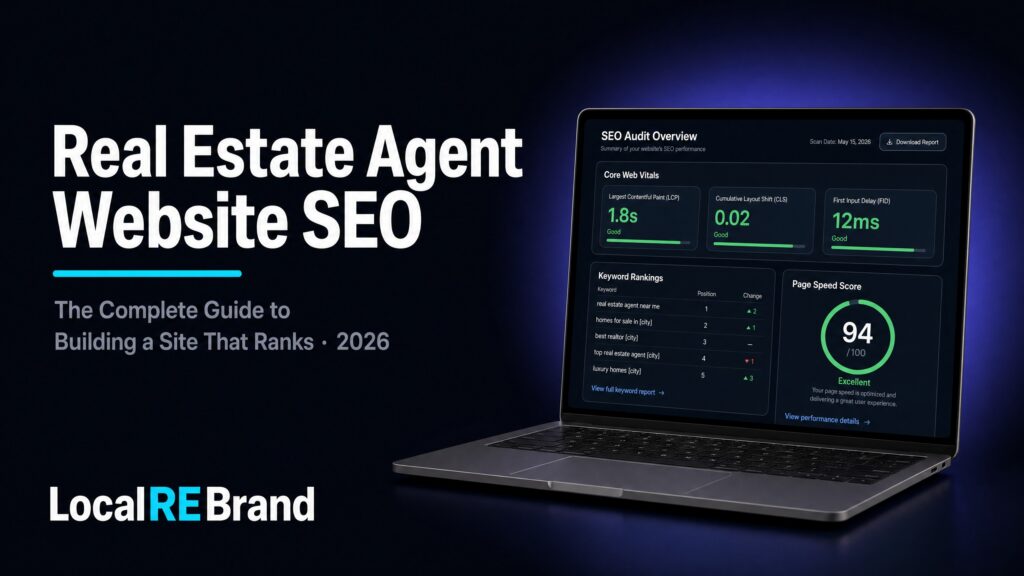
- Core Web Vitals 2026: LCP under 2.5s, INP under 200ms (replaced FID in March 2024), CLS under 0.1. The new Visual Stability Index (VSI) launched in early 2026.
- IDX/MLS-driven listing pages are thin/duplicate content by default. Without a hyperlocal content layer, the rest of the site can’t carry the SEO weight.
- Schema markup is now a primary input for AI search citations (ChatGPT, Perplexity, Google AI Overviews). Every page should have appropriate schema.
- Property details pages convert when they include floor plans (93% of buyers find them useful), HOA fees, taxes, and square footage clearly displayed (Weweb, 2026).
- The CMA/home valuation page is the highest-converting seller lead capture on most agent websites.
Why Your Website Is the Asset Local SEO Stands On
I’ve watched hundreds of real estate agents make the same mistake. They obsess over their Google Business Profile (good), invest in reviews (good), pour money into Facebook ads (debatable) — and they let their website rot. Three-year-old WordPress theme, broken IDX search, missing schema, mobile UX from 2019.
Here’s the math that should change that calculus:
- 44% of local clicks go to the map pack. 29% go to organic. 21% go to paid ads (Hooked Marketing, 2026).
- That 29% organic share — almost a third of all local search traffic — goes entirely to websites, not GBPs.
- AI search engines (ChatGPT, Perplexity, Google AI Overviews) pull from your website’s structured data and content when generating their answers. 31%+ of US adults use generative AI search in 2026.
- Long-tail keywords (“relocating to Stapleton Denver from California,” “best schools in Park Hill”) never enter the map pack at all. They go straight to organic, which means straight to websites.
A great GBP + a terrible website is leaving more than half your potential leads on the table. This guide is the complete website SEO playbook.
The 2026 Stack: What Google Actually Wants From a Real Estate Site
Here is the simplified mental model I use with clients. Google evaluates your website on five layers, in this order:
Layer 1: Crawlable & Indexable. Can Google reach every important page? Is your robots.txt clean? Are there no accidental noindex tags on key pages?
Layer 2: Mobile & Fast. Does the mobile version pass Core Web Vitals? Does it load fast enough on a 4G connection?
Layer 3: Structured & Semantic. Does your HTML tell Google what each page is about (title, headings, schema)? Does your content cluster around topics?
Layer 4: Authoritative & Trustworthy. Real estate is YMYL. Do you have author bios, contact info, license numbers, professional credentials? Does your site demonstrate EEAT?
Layer 5: Useful to a Real User. Does the content actually help a buyer or seller, or is it generic real estate filler? Does it match the search intent of the keyword?
A page that nails all five ranks. A page that fails one drops out. Most agent websites I audit fail two to three layers. Fixing those is the cheapest performance win available.
Site Architecture: The Pages You Must Have
Every real estate agent website should have, at minimum:
Home page. Hero with a clear promise tied to your market (“Helping families buy and sell in Denver’s east-side neighborhoods since 2018.”). Embedded property search. Authority block (years experience, transactions closed, designations, featured-in logos). CTA above the fold.
About page. Your bio, headshot, designations, license number, story. This is your single most important EEAT page — Google reads it as the “Author” entity that backs the whole site.
Service pages.
– “Buying a Home in [Market]”
– “Selling a Home in [Market]”
– “Relocating to [Market]”
– “Investing in [Market]”
– Niche pages if you specialize (luxury, first-time, condos, equestrian, etc.)
Neighborhood pages. One pillar page per neighborhood you actively serve. Original content, embedded map, market stats, schools, amenities, photos. The most underrated SEO asset on a real estate website.
CMA / Home Valuation page. Separate page with a clear lead form. Highest-converting seller lead magnet most agent sites have (Weweb, 2026).
Property search / IDX. Necessary, but treat it as a tool, not an SEO play (more below).
Listing detail pages. From IDX. Enrich where possible.
Blog / Resources. Hyperlocal content, market updates, buyer/seller guides. The engine of long-tail traffic.
Testimonials / Reviews. Embedded reviews with proper schema.
Contact. Phone, email, hours, embedded map, contact form.
Legal pages. Privacy policy, terms, accessibility statement, Fair Housing notice. Required.
Author archive pages. If you write the blog, your author page reinforces EEAT and aggregates your content.
Most agent sites are missing 3–5 of these. Deep dive in Real Estate Agent Website Architecture: Pages You Must Have (and What to Avoid).
URL Structure and Site Hierarchy
URLs are user-facing and crawler-facing. Both matter.
The rules I make every client follow:
- Lowercase, hyphenated, no stopwords, ≤ 60 characters.
- Logical hierarchy that reflects content structure:
- Neighborhood pages:
/neighborhoods/stapleton-denver/ - Blog posts:
/blog/post-slug/or/post-slug/ - Service pages:
/buy/,/sell/,/relocate/ - About:
/about/ - No dates in URLs of evergreen content. A URL with
/2024/in it looks stale by 2026. - No page-ID URLs.
/?p=842is a developer convenience and an SEO disaster. - Permanent redirects (301) when URLs change. Never break a URL that’s earned backlinks.
If you’re migrating an existing site, map every old URL to its new one and set up 301 redirects before launch. URL migrations done badly are the single most common cause of overnight ranking collapses I’ve seen.
Title Tags, Meta Descriptions, and H1s for Real Estate Pages
Title tags are your single most important on-page SEO element. Three rules:
- One unique title per page. No duplicates, no generic “Home” or “About Us.”
- Primary keyword at or near the front.
- Brand at the end. Format: “Page Topic | Hyperlocal Modifier | Brand.”
Examples that work:
| Page | Title tag |
|---|---|
| Home | Denver Real Estate Agent Serving East Side Neighborhoods |
| About | About Jon Smith — Denver Real Estate Agent Since 2018 |
| Stapleton | Stapleton Denver Real Estate Agent and Neighborhood Guide |
| Sell | Sell Your Denver Home — Free CMA and Pricing Strategy |
| CMA | What’s My Denver Home Worth? Free Instant Valuation |
| Buyer Guide | First-Time Homebuyer Guide for Denver |
Meta descriptions are 145–155 characters, include the keyword, include a clear benefit, written to earn the click.
H1s are one per page, match the search intent of the title, written for humans.
Most agent websites have title tags like “Home” or “John Smith Real Estate.” Fix this in week one. It moves rankings faster than almost any other on-page change.
Core Web Vitals 2026 (LCP, INP, CLS, VSI)
Core Web Vitals are Google’s quantified measure of user experience. They are a confirmed ranking factor. In 2026 there are four to track:
| Metric | Good | Needs Improvement | Poor |
|---|---|---|---|
| LCP (Largest Contentful Paint) | < 2.5s | 2.5–4.0s | > 4.0s |
| INP (Interaction to Next Paint) | < 200ms | 200–500ms | > 500ms |
| CLS (Cumulative Layout Shift) | < 0.1 | 0.1–0.25 | > 0.25 |
| VSI (Visual Stability Index, new in 2026) | tracking phase | — | — |
INP replaced FID (First Input Delay) in March 2024. INP measures responsiveness across all interactions on a page, not just the first one. It is the metric most real estate websites currently fail because of heavy JavaScript IDX widgets and filter-heavy listing pages (1604 Lab, 2026).
The most common Core Web Vitals fixes for real estate sites:
- LCP fixes: Compress and right-size hero images. Use WebP. Lazy-load below-the-fold images. Move hero image to inline or
<link rel="preload">. - INP fixes: Reduce JavaScript bundle size. Defer non-critical scripts. Replace heavy third-party widgets with lighter alternatives. Most IDX plugins are INP disasters — pick a lightweight one.
- CLS fixes: Set explicit dimensions on every image and ad. Reserve space for embedded widgets. Avoid injecting content above the fold after page load.
Test monthly with PageSpeed Insights. Run on mobile, because mobile is what Google ranks.
Full implementation in Site Speed for Real Estate Websites: 12 Fixes That Actually Move Rankings.
Mobile-First: The 65% of Your Traffic
Google has indexed the mobile version of every website as primary since 2024 (Google Search Central). If your mobile site is broken, you don’t rank. Period.
The mobile-first rules I make every agent client follow:
Responsive design, not separate mobile. One HTML, one URL, adapted layouts. Google explicitly recommends responsive over separate m. subdomains.
Content parity. Every piece of content visible on desktop must also be visible on mobile. Hidden content (accordions, behind tabs, in modals) gets lower weight. If you have a 2,500-word neighborhood page on desktop, those 2,500 words need to be present on mobile.
Tap targets and thumb zones. Buttons sized 44×44 minimum. Critical CTAs in the thumb zone (bottom of screen). Sticky “Call” and “Search” bars on listing pages and home pages.
Mobile image strategy. Smaller file sizes, modern formats (WebP), proper sizing for the viewport. Lazy load below-the-fold.
Mobile navigation. Clean hamburger menu. Search prominent and accessible. No 7-level deep nested menus.
Schema on mobile. Same structured data on both versions.
Test with Google’s Mobile-Friendly Test. Run the test on every important page, not just the home page.
Full mobile playbook in Mobile SEO for Real Estate Agents: Why Your Site Loses Half Your Leads.
IDX and MLS Integration: The Duplicate-Content Trap (And How to Beat It)
This is the section that surprises most agents.
IDX (Internet Data Exchange) feeds your real estate website with live MLS listings. The same MLS feed goes to every other agent’s website in your market. Google sees thousands of identical listing pages across competing agent sites and has no way to know which one should rank (JVG Labs, 2026).
The result: your IDX-driven listing pages almost never rank organically. Google treats them as thin/duplicate content and either deprioritizes them or doesn’t index them at all.
This is also why most agent websites get less organic traffic than they should — the bulk of their pages are pages Google has decided to ignore.
The strategies that work in 2026:
1. Don’t try to rank IDX listing pages. Rank around them. Build your hyperlocal neighborhood pages, market reports, buyer/seller guides — those are the pages that earn the rankings and feed the IDX with traffic.
2. Use noindex on filter combinations and search results. Indexing every possible price range × neighborhood × bedroom combination creates infinite low-value pages. Noindex these to preserve crawl budget.
3. Enrich IDX with original content where possible. If your IDX plugin allows agent-added commentary on listings, add it. Personalized neighborhood context for listings.
4. Pick a lightweight IDX plugin. Heavy IDX widgets are the #1 source of Core Web Vitals failures. Lightweight options (Showcase IDX, IDX Broker Platinum’s modern templates) outperform bloated alternatives.
5. Build a content moat around your IDX. Neighborhood guides, market reports, school district pages, “living in” content. This is where organic rankings come from, and it’s where IDX pages drive their traffic to.
Deep dive in IDX/MLS Integration and SEO: What Most Agents Get Wrong.
Schema Markup for Real Estate Websites
Schema markup is JSON-LD structured data you add to your pages telling Google (and AI engines) exactly what each page is about. In 2026, schema is no longer optional — it is the primary input for AI search citations.
The minimum schema setup for a real estate agent website:
Site-wide:
– Organization schema on every page (your business identity)
– BreadcrumbList schema on every non-home page (navigation hierarchy)
Home page:
– RealEstateAgent or LocalBusiness schema with full NAP, service areas, license number, designations
– WebSite schema with sitelinks search box
About page:
– Person schema for the agent (name, headshot, credentials, social profiles)
Blog posts:
– Article + Author (Person) schema
Neighborhood / service pages:
– Place schema for neighborhoods
– Service schema for services
– FAQPage for embedded FAQs
Listing pages:
– RealEstateListing or Product schema with property details
Testimonials:
– Review and/or AggregateRating schema (must match visible content per Google’s rules)
Validate every page with Google’s Rich Results Test before publishing. Recheck quarterly — Google’s schema requirements update.
Full implementation walkthrough in Real Estate Schema Markup Guide for Agents (With Examples).
Internal Linking and Topical Authority
Internal links — links from one page on your site to another — are how Google understands your site’s hierarchy and topical coverage. They are also how you pass “link equity” from your highest-authority pages (home, about) to your most-conversion-focused pages (neighborhood pages, CMA, service pages).
The rules:
- Every page links to its parent and its siblings. A Stapleton neighborhood page links up to the neighborhoods hub, sideways to nearby neighborhoods (Park Hill, Lowry), and down to specific Stapleton blog posts.
- Every blog post links to relevant pillar pages. Hub-and-spoke discipline.
- Anchor text is descriptive and varied. Never identical, never just “click here.”
- No orphan pages. Every important page should have at least 2–3 internal links pointing to it.
- Update internal links when you publish new content. New post about Stapleton schools? Link to it from the Stapleton pillar.
Internal linking compounds. Done weekly for a year, it can double your organic traffic on existing content without writing a single new post.
Content Strategy: Hyperlocal Pages + Service Pages + Blog
Content is what makes your website rank. Not design. Not branding. Content.
The three content layers every real estate website needs:
Layer 1: Hyperlocal neighborhood pages. One per neighborhood, 2,500+ words each. Original content: market stats, schools, parks, restaurants, amenities, sub-neighborhoods, “living in” perspective, photos.
Layer 2: Service pages. “Buying,” “Selling,” “Relocating,” “Investing” — and any specialty you serve. 1,500–2,000 words each. Written to convert, not just to rank.
Layer 3: Blog content. Long-tail informational content. 1,800–2,500 words per post. Hyperlocal, time-relevant, helpful. The engine of recurring organic traffic.
Sequence to build them:
- Month 1–2: Service pages + the 3 highest-volume neighborhood pages.
- Month 3–4: Next 5 neighborhood pages + first 8 blog posts.
- Month 5+: Blog cadence (2–4 posts/month) plus completing neighborhood coverage.
Full content strategy is in the Real Estate Content Marketing and Blogging pillar.
Conversion Optimization (Lead Gen Without Hurting SEO)
A real estate website that ranks but doesn’t convert is just decoration. Three principles:
1. Multiple lead capture mechanisms. Different visitors convert on different offers. Mix:
– Buyer search (IDX)
– Home valuation / CMA
– Neighborhood guide PDF
– Buyer or seller checklist
– Free consultation booking
– Email newsletter signup
2. Strategic CTA placement. Above-the-fold primary CTA. Mid-content secondary CTA. End-of-content tertiary CTA. Exit-intent popup on high-traffic pages only.
3. SEO-friendly forms. Forms above the fold are great for UX but can hurt LCP. Use a button that opens a modal instead of an inline form on the hero. Keeps the page fast and lets users engage when ready.
Don’t sacrifice SEO for conversion. Aggressive popups, intrusive interstitials, and pop-up gates can trigger Google’s intrusive interstitial penalty. Test every conversion element against Core Web Vitals impact before going live.
Tracking and Measurement
What to measure on a real estate website:
Traffic. Sessions, users, channel breakdown, top landing pages. Look at trends, not raw numbers.
Rankings. Keyword positions for your target terms. Use Ahrefs, SEMrush, or BrightLocal. Track the 30 most important keywords monthly.
Engagement. Time on page, scroll depth, pages per session. Bounce rate is mostly a vanity metric — engagement is the real signal.
Conversions. Form fills, calls (with call tracking), CMA requests, IDX registrations, newsletter signups. Tag each conversion source.
Technical health. Core Web Vitals (monthly), broken links (monthly), schema validation (quarterly), mobile usability (monthly).
AI citations. New in 2026: track whether ChatGPT, Perplexity, and Google AI Overviews are citing your site. Tools like Ahrefs Brand Radar and Profound are emerging here.
Build a simple monthly dashboard. The agents who actually look at their numbers improve their numbers.
WordPress vs Other Platforms for Real Estate Agents
The platform debate is overblown. Most platforms can rank if used well. The real question is which one fits your workflow.
WordPress: Most flexible, largest plugin ecosystem (Yoast, RankMath, schema plugins, IDX integrations). Steepest learning curve. Highest ceiling. What most professional agent sites use in 2026.
Squarespace: Cleaner design, easier to maintain, weaker SEO controls and limited IDX integration options. Good for solo agents who prioritize ease over flexibility.
Wix: Improved a lot but still SEO-limited at the technical level. Not recommended for agents who want serious organic traffic.
Webflow: Designer-friendly, strong technical SEO, lower content management velocity. Good for design-forward brands.
Real Geeks, Sierra Interactive, BoomTown, kvCORE: Real-estate-specific platforms with built-in IDX. Strong CRM integration, decent SEO defaults, less flexibility. Good for agents who want everything-in-one.
Custom-built: Highest ceiling, highest cost, requires ongoing dev resources. Only justified if your business model demands it.
My default recommendation in 2026: WordPress with a fast theme (GeneratePress, Kadence) + RankMath or Yoast + Showcase IDX or IDX Broker + a hyperlocal content cadence. That stack outperforms most agent-specific platforms for organic visibility.
The 30/60/90 Plan
If you’re starting from a broken or non-existent website, here’s the sequence:
Days 1–30: Foundation.
– Choose platform and theme
– Build the 12 required pages (home, about, contact, 4 services, 3 neighborhoods, CMA, legal)
– Set up IDX (lightweight plugin)
– Title tags + meta descriptions on every page
– Schema markup site-wide + per-page
– Mobile-friendly test passing
– PageSpeed Insights baseline
Days 31–60: Optimization.
– Build 5 more neighborhood pages
– Add 4 blog posts (hyperlocal)
– Fix any Core Web Vitals failures
– Internal linking audit
– Set up Google Search Console + Google Analytics 4
– Schema validation across all pages
Days 61–90: Authority.
– 4 more blog posts
– Add testimonials with schema
– First Search Console performance review
– Submit XML sitemap
– Set up tracking dashboards
– Quarterly audit cadence established
After 90 days you should have a complete, technically sound, content-rich agent website. The next 12 months are about cadence and compounding.
Frequently Asked Questions
Q: How much should I spend on a real estate agent website?
DIY with WordPress + a quality theme + IDX: $500–$1,500 setup, $50–$200/month ongoing. Professionally built: $3,000–$10,000 setup, $100–$500/month. Custom: $10,000+ setup. Most solo agents should be in the DIY-with-help tier.
Q: How long does SEO take to work on a new real estate website?
Hyperlocal long-tail terms: 4–6 months. Broader local terms: 12–18 months. AI search citations: as little as 4–8 weeks with proper schema. Map pack: 6–10 weeks with proper GBP + website alignment.
Q: Do I need a blog?
Yes. The blog is the engine of long-tail organic traffic. Agents without blogs are leaving the easiest organic wins on the table.
Q: How often should I update my website?
Weekly: blog posts, market data refreshes, new testimonials. Monthly: Core Web Vitals check, broken link check. Quarterly: schema validation, full site audit, content refresh on top pages. Annually: design refresh evaluation, full content overhaul.
Q: Should my listing pages be indexed?
Selectively. The clean property detail page for an active listing — yes, index. Filter combination URLs (price + bedrooms + neighborhood) — noindex. Old, expired listings — noindex or redirect. Crawl budget management matters when you have thousands of listings.
Q: What’s the most common mistake on agent websites?
A toss-up between: (1) generic title tags that don’t include keywords or location, and (2) IDX heavy enough to fail Core Web Vitals. Both are easy to fix and most agents have one or both.
Q: Does my website need to integrate with my CRM?
Yes, ideally. Forms should push leads directly into your CRM with attribution data. Manual lead entry is friction, friction kills follow-up speed, and follow-up speed is the single biggest conversion variable.
What to Do This Week
If you only do five things this week:
- Audit your title tags. Every page should have a unique title that includes a keyword and your market.
- Run PageSpeed Insights on your home, about, and top neighborhood page. Mobile score 80+ is the floor.
- Verify schema markup with Google’s Rich Results Test on your home and about pages.
- Check Google Search Console for indexing errors. Fix the top 10 issues.
- Confirm your site passes the Mobile-Friendly Test on every important page.
Two to three hours of work. Will outperform any single paid ad spend you’ll make this month.
For a free 30-minute website SEO audit, book here.
Jon Smith is a 20+ year SEO veteran specializing in real estate agent websites. He has audited and rebuilt sites for hundreds of solo agents, teams, and brokerages across North America. Connect on LinkedIn or read more on LocalReBrand.com.
Sources & further reading:
- Core Web Vitals 2026: Complete Guide — 1604 Lab
- Mobile-First Indexing Best Practices — Google Search Central
- Real Estate SEO: Is Your IDX Feed Hurting Your Rankings? — JVG Labs
- Why IDX Property Pages Struggle with SEO — AgentFire
- Real Estate Homepages: 15 Must-Have Features 2026 — Weweb
- WordPress Real Estate SEO Architecture — Fachremy Putra
- Local SEO Statistics 2026 — Hooked Marketing
- How can I evaluate whether an MLS/IDX plugin will hurt or help SEO — MLS Import